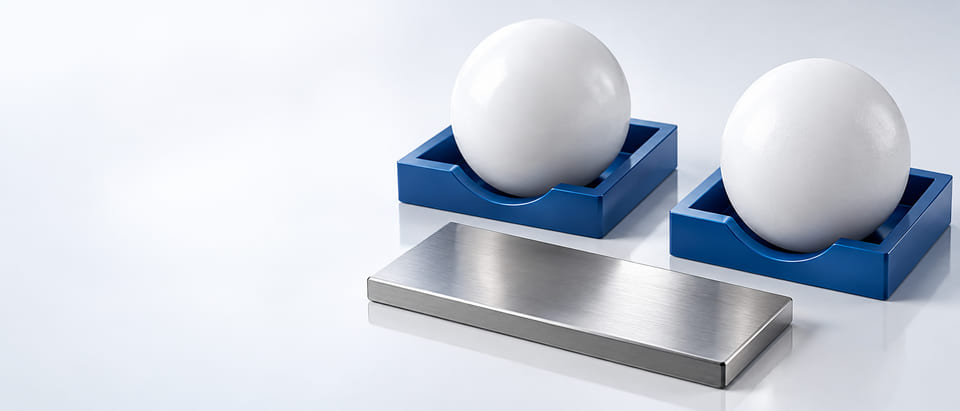
Polyethylene ball enquiries often begin with low weight or a white appearance. For a wear-prone guide or impact contact, the more useful distinction is the exact polymer grade and how its molecular structure, processing and finished geometry behave in the complete contact.
Quick Answer: Are UHMWPE Balls Better Than HDPE Balls?
UHMWPE can be attractive for sliding wear and impact service, but it is not an automatic replacement for HDPE. UHMWPE describes an ultra-high molecular-weight polyethylene family; HDPE identifies a high-density polyethylene family. The abbreviations do not form a simple high-density-versus-low-density ranking, and neither identifies every additive or processing condition.
Compare the actual proposed grades under the intended load, speed, counterface, temperature and fluid. Inspect the mating surface as well as the ball. A material that loses less mass can still deform excessively, produce unacceptable debris or wear the opposing component.
For a component enquiry, use MEITUO’s polymer material-selection route to define the wear or impact problem before requesting alternatives. Ask what the offered UHMWPE and HDPE specimens represent and how the finished sizes are controlled. When both pass the real duty, commercial factors can decide; when neither passes, a broader material or geometry change may be necessary.
What Do UHMWPE and HDPE Names Actually Tell a Ball Buyer?
The family names describe different aspects of polyethylene. Molecular weight strongly influences chain entanglement, processing and mechanical response. Density relates to structure and composition but is not a complete predictor of abrasion or impact behavior. A supplier should therefore identify the actual grade rather than offer generic PE with an informal performance label.
Specify whether the ball is solid or hollow and whether the comparison concerns a load-carrying sphere, floating element or another construction. Wall thickness, seams and construction can dominate a hollow-ball comparison. Do not transfer a solid-stock datasheet directly to a thin shell or assume that nominal outside diameter establishes equivalent mechanical behavior.
Ask about modifiers and colorants when purity, electrical properties or product contact matters. A wear-modified grade can differ from the natural unfilled resin in ways that are beneficial for one duty and unsuitable for another. A black appearance does not identify a particular additive, and a white appearance does not prove an unfilled or virgin material.
Keep grade identity separate from finished-ball acceptance. The correct polyethylene can still have the wrong diameter, shape, surface or residual processing condition for the mechanism. Conversely, a dimensionally conforming sphere does not prove the requested polymer was supplied. The purchasing record needs both answers, with a reasonable link between the material evidence and the finished lot.
How Should Sliding Wear Be Distinguished from Impact Damage?
Sliding wear involves repeated relative movement at a contact; impact involves a transient event with a different distribution of energy and stress. An abrasion result does not establish impact resistance, and a drop test does not establish acceptable long-term sliding wear. Identify which mechanism actually limits the assembly.
For sliding, specify counterface material, hardness where relevant, finish, motion path, load, speed, lubrication and contaminant condition. Polymer transfer films and embedded particles can change the result as a test proceeds. If the real contact sees dust or slurry, a clean dry coupon may screen materials but does not reproduce that environment.
For impact, identify the striker or mating geometry, mass, velocity or drop arrangement, support condition and temperature. A sphere confined in a pocket can behave differently from a freely supported specimen. Inspect for permanent flattening, local cutting, crack-like damage and changes in subsequent movement. A ball that survives an impact without separation may still fail the dimensional requirement.
For a practical diagnostic tool, classify the removed ball before selecting a test. A polished sliding track suggests repeated contact, but still needs a mating-surface inspection. A localized flat after a known strike suggests an impact or overload question. Embedded hard particles point toward third-body abrasion. A broadly changed diameter after a warm dwell suggests that deformation or conditioning deserves attention. These observations are hypotheses, not material-identification methods. More than one mechanism can occur on the same specimen.
Retain the used counterpart, operating history and an unused ball from the same identified proposal when possible. Comparing only a damaged UHMWPE specimen with a new HDPE sample confounds material with service history. If the original ball cannot be identified, label the comparison as exploratory and obtain controlled candidates before making an equivalence decision. An attractive photographic surface alone cannot resolve the unknown material, exposure or contact history.
Do not combine the two mechanisms into one unexplained durability score. A useful development matrix has a sliding branch and an impact branch, with a shared post-test functional check. If the application includes both, test the sequence: impact damage can alter the following wear behavior, while a worn contact can change the next impact. State which order represents the actual duty.
UHMWPE vs HDPE: Which Evidence Belongs in the Decision Table?
The table should make uncertainty visible. A material-family tendency is a reason to investigate a candidate, not a substitute for evidence at the required contact. Evaluate the proposed finished ball and its mating component as a pair.
Add a dimensional check after the test and after an agreed recovery period. A soft or viscoelastic specimen may show different geometry immediately after unloading and after conditioning. The operating function may depend on either state, so the acceptance rule must identify which one is relevant.
Examine local shape as well as average diameter. A worn flat or impact indentation can affect rolling, sealing or guide behavior while leaving some diameter readings almost unchanged. Choose a measurement approach capable of finding the expected damage and record its location relative to the contact.
When a supplier provides a datasheet comparison, check the method and units before ranking numbers. Different abrasion methods, specimen arrangements or conditioning make direct numerical comparison unreliable. A reported impact value also needs its test geometry and whether a notch was used. If the necessary method information is absent, request clarification rather than treating the largest number as the best ball.
| Requirement | UHMWPE proposal | HDPE proposal | Needed comparison |
|---|---|---|---|
| Sliding wear | Identify exact high-molecular-weight grade | Identify exact high-density grade | Same counterface, load and motion |
| Impact response | Assess local deformation and recovery | Assess the same damage endpoints | Defined impact arrangement and temperature |
| Stable fit | Include creep and thermal movement | Include creep and thermal movement | Loaded dimensions and functional clearance |
| Product cleanliness | Check additives and debris | Check additives and debris | Application-specific contamination limits |
How Can an Illustrative Wear Calculation Be Kept Honest?
Suppose two hypothetical solid-ball specimens are cleaned and conditioned by the same defined procedure before and after a sliding test. Candidate A loses 8 mg and candidate B loses 12 mg over 2,000 m of sliding. Their mass-loss-per-distance results are 0.004 mg/m and 0.006 mg/m. Candidate A shows one-third less mass loss under those assumed conditions. These are invented test records, not UHMWPE or HDPE catalogue values.
If volume loss is required, use the identified density of each candidate and carry the units through the calculation. With an assumed density of 0.94 mg/mm³ for A, 8 mg corresponds to approximately 8.51 mm³. That assumed density must not be used for an unknown formulation, and the calculated volume does not describe the location or shape of the wear scar.
The mass difference alone cannot establish where all lost material went. Debris may remain on the counterface, in the fixture, in a filter or in the test fluid. Nor does a lower mass loss establish lower friction, better dimensional function or less mating-part damage. Record those outcomes independently.
Check whether the balance resolution, cleaning repeatability and conditioning variation can support the observed difference. If a cleaning control changes by several milligrams, interpreting an 8-versus-12 mg comparison becomes questionable. Include blank or handling controls where useful, retain raw readings and report the limits of the comparison instead of presenting an unsupported precision.
Why Do Temperature, Creep and Manufacturing Route Matter?
Polyethylene behavior changes with temperature and time under load. A short room-temperature contact trial may not reveal dimensional change during a warm loaded dwell. The relevant temperature is the actual ball/contact state, including frictional heating and nearby process heat, not only the room air.
Use material-specific thermal and mechanical data as screening information. A published melting temperature is not an allowable service temperature for a loaded sphere. Similarly, a short-term or long-term material guideline does not establish the dimensional performance of every finished ball at that temperature. The acceptable limit depends on load, duration, geometry and function.
Processing route can influence dimensions, internal condition and consistency. Ask how the offered sample relates to the proposed repeat supply, including whether the ball is machined from stock or formed by another route. The request need not prescribe a process without reason, but it should preserve any processing condition that the qualification actually depends on.
For a guide or seat, establish a clearance budget that includes initial tolerances, thermal movement, loaded deformation and contamination allowance. Do not subtract a guessed wear benefit from an unmeasured creep risk. A material can be attractive for abrasion while requiring a different geometry or load distribution to meet stable-fit requirements. If that redesign is permitted, evaluate it as a new configuration and retain its own result.
What Qualification Record Makes the Material Choice Repeatable?
Assign separate sample codes to the sliding, impact and combined-sequence groups so that a previously damaged specimen is never mistaken for an unused control.
Create a contact dossier with the drawing, grade proposals, specimen identity, counterface description and test sequence. Record why UHMWPE and HDPE were shortlisted and which result would reject either candidate. This gives the final decision more value than a statement that one material performed well.
Include photographs under repeatable lighting and a scale where surface features are being compared. Photograph the contact before cleaning if deposits or transfer films may matter, then document the cleaned measurement condition separately. Keep specimen orientation where a particular region receives the load. Otherwise a later diameter check may miss the exact area that controlled failure.
Reserve enough specimens to distinguish development diagnosis from repeatability. Reusing a damaged ball after changing the counterface does not provide a clean material comparison. If only a small number is available, state that limitation and do not imply population capability from a single favorable result.
Translate the accepted outcome into an order requirement: grade identity, construction, dimensions, required records, packaging and permitted changes. A switch between polyethylene families or to a modified formulation should not be treated as an administrative substitution. For recurring orders, identify which incoming checks confirm the purchased component and which periodic or change-triggered tests preserve the original application decision.
Where Should Buyers Source UHMWPE and HDPE Ball Evidence?
The strongest sourcing conversation separates ball availability from material technical support. Regional suppliers can help define an exact proposal, but the buyer still needs a consistent test basis for the complete wear or impact contact.
China: Qingdao, Shandong
MEITUO Balls provides a China-based enquiry route for the finished sphere and its intended duty. Send the solid or hollow construction requirement, contact sketch and observed wear or impact problem. Request confirmation of the exact polyethylene proposal, sample source and measurement scope. For an overseas OEM, make the sample codes visible to both the Chinese source and the receiving laboratory.
Italy: Cinisello Balsamo, Milan
RGPBALLS publishes distinct UHMWPE and HDPE ball pages from Cinisello Balsamo. That finished-ball catalogue route can support an Italian sourcing comparison. Ask which specific grade and construction are offered in the required size. Use the same counterface and temperature conditions when evaluating its proposal against another source; the two published material names are not test results for the application.
Germany: Nufringen, Baden-Württemberg
Ensinger is headquartered in Nufringen and works with engineering-plastic compounds, stock shapes and parts. Its technical information offers a material and processing reference route for a German development team. It should not be read as proof that a particular loose-ball product is available. Connect any stock-material guidance to the exact finished component and its proposed processing history.
Use a shared contact dossier when comparing domestic and imported options. Quote evaluation should include the cost of preserving identity and repeating the relevant test, not just the resin family or freight distance. Confirm current availability and the responsible legal seller for the actual order.
How Can MEITUO Support a Polyethylene Ball Enquiry?
MEITUO Balls is the ball-focused website of Qingdao Meituo Steel Co., Ltd., based in Qingdao, China. The published company profile describes its specialty-steel background. A polymer-ball enquiry should establish the particular offered material, source and component evidence before samples or recurring supply are agreed.
For UHMWPE-versus-HDPE selection, explain whether the target is lower abrasion, impact survival, stable fit or product cleanliness. Provide the counterface and operating conditions alongside the ball drawing. This helps keep the proposal focused on the actual limiting mechanism instead of a generic wear-resistant label.
Use the sampling and validation route to organize the specimen plan. The quotation page and [email protected] can carry the contact dossier and expected quantities. Ask which requirements are confirmed for the order and which remain part of development. Preserve that distinction when comparing the commercial offers.
UHMWPE vs HDPE Balls FAQ: What Should Buyers Ask?
Is UHMWPE simply a higher-density version of HDPE?
No. UHMWPE emphasizes ultra-high molecular weight, while HDPE identifies a density-related polyethylene family. The exact grade and processing condition are needed to compare finished-ball behavior.
Does better abrasion resistance prove better impact service?
No. Sliding abrasion and impact are different mechanisms. Define the impact arrangement and inspect deformation and subsequent function independently of the sliding-wear result.
Can a polyethylene melting point be used as its working limit?
No. A loaded ball can lose dimensional function well before melting. Temperature, exposure time, contact force, geometry and the required clearance determine the relevant application limit.
Should wear be measured only by ball mass loss?
Mass loss can be useful when the method supports it, but also inspect local shape, the mating surface, debris and function. Cleaning and conditioning variation must be small enough to interpret the mass difference.
Why does a test need the actual counterface finish?
Counterface material and finish affect friction, transfer films and abrasion. A favorable result against one smooth coupon does not establish the same performance against a rougher, contaminated or different mating surface.
What should a repeat-order specification preserve?
Preserve the accepted polyethylene grade, construction, drawing, inspection state and relevant qualification reference. Define notification or approval for changes that could alter wear, impact, contamination or fit.