Slide {count} of {total}: {title}PageLoading pages…{count} matching pagesUseful starting pointsNo matching pages. Try a material, application or service name.Search is temporarily unavailable. Use the navigation menu or email [email protected].{count} of {total} product options{count} of {total} product options match your search{count} products shownOpening the enquiry form with your product-family requirements.Enquiry brief downloaded. You can also continue to the enquiry form with these requirements.Requirements changed. Prepare the enquiry again to update the details carried to the enquiry form.Enquiry focus: {focus}. Your existing entries are preserved.Your selected requirements have been added to your message. You can edit them before sending.Your saved selections are unavailable or have expired. Return to the previous page and choose “Use in My Enquiry” again, or enter your requirements in the form below.Your saved selections could not be read. Return to the previous page and choose “Use in My Enquiry” again, or enter your requirements in the form below.Please complete this required field.This field allows {count} characters. Your complete selection is still shown; shorten this field before sending.Requirements including the enquiry source exceed {count} characters. Your complete text is still shown; shorten the requirements before sending.No files selected{count} file selected: {files}{count} files selected: {files}Choose up to {count} reference files.Each reference file must be 20 MB or smaller.Choose a supported document, image, spreadsheet, ZIP or drawing file. See the formats listed below the file field.Not providedSending your enquiry and selected attachments to Zoho…Online submission is temporarily unavailable. Please email [email protected].{count} selectedSelect the checks your application needs.{count} of {total} applications{count} validation items selectedSelect the validation topics you want to discuss, or start with the application.{count} of {total} markets{products} product candidates · {topics} review topics selectedConcept illustrationCGI application conceptProduct quotationMaterial selectionDrawing reviewInspection and documentsCompany qualificationCustom component reviewSamples and validationQuality and documentsOEM partnershipDistribution enquiryEngineering projectMEITUO BALLS — COMPONENT ENQUIRYMEITUO BALLS — PRODUCT ENQUIRYMEITUO Balls enquiryMEITUO BALLS APPLICATION ENQUIRYMEITUO BALLS · MARKET ENQUIRYEnquiry type: {value}Enquiry focus: {value}Requested enquiry focus: {value}Name: {value}Phone: {value}Email: {value}Company: {value}Company / contact: {value}Name / company: {value}Destination / market: {value}Product / material: {value}Product: {value}Product family: {value}Product page: {value}Reference: {value}Drawing / revision: {value}Diameter / units / tolerance: {value}Diameter / drawing / units: {value}Sample & production quantities: {value}Sample and production quantity: {value}Material / grade: {value}Working and cleaning conditions: {value}Application / acceptance: {value}APPLICATION, CONDITIONS & ACCEPTANCEMESSAGEApplication and requirements:REFERENCE FILESREFERENCE FILES TO ATTACH MANUALLYNone selectedTo be providedTo be reviewedSource: {value}Enquiry source: {value}Please review material, construction, acceptance, documents, quantities and commercial scope.Please review material / construction, dimensions, environment, quantities, inspection and quotation terms.Please review feasibility, specification, documentation, sample conditions, packaging and quotation.Inspection review requested:Page: {value}Application: {value}Selected validation topics:Please add material, diameter and units, quantity, drawing revision, working conditions and document requirements.Market: {value}Project: {value}Component / size / units: {value}Quantity: {value}Selected product candidates:Selected review topics:Notes: {value}
Evaluate Before Approval
Sampling & Application Validation
Give every sample a clear question, representative conditions and a recorded purchasing decision.
Quick answer
Sampling and validation planning defines what a trial component must demonstrate before it can support an application or purchasing approval. Separate material identity, incoming inspection and assembly performance, then record the conditions, sample reference and acceptance criteria. A useful trial resolves a specific uncertainty and preserves the result for the next decision; receiving a sample or observing one successful operation is not the complete approval.
Start with the identity, drawing and material records associated with the proposed sample. Define the dimensional, surface or document checks needed before it enters a trial. This route is useful when a new source or revised component must first demonstrate that it represents the intended item rather than merely a similar-looking sphere.
For ball-and-seat sets or another functional pair, define the mating parts and actual operating conditions. The trial should establish the assembled result that matters, such as closure or contact marking. Keep it separate from loose-ball inspection so one successful measurement is not mistaken for complete application acceptance.
Use a controlled comparison when materials or media remain open. A finishing-media sample, for example, needs a defined workpiece and outcome. Record which variable changes and what stays fixed, so the result can distinguish the candidates instead of mixing material, equipment and preparation changes together.
A sample is most useful when its purpose is agreed before it arrives. The question might concern fit, closure, wear or a material alternative, and each needs a different evaluation. Identify which requirement remains uncertain, which conditions matter and who accepts the result. Sampling review organizes that information into a practical plan, so the trial produces a usable decision record instead of a collection of impressions.
01 / IN CONTEXT
Write the Trial Question Before Choosing the Sample
State the decision the trial needs to support. Does the part fit the approved assembly, does a contact close under the specified conditions or does a material alternative address the observed problem? Identify the relevant drawing, material state and surface preparation, and assign the sample a clear reference. Separate preliminary comparison from final approval. An exploratory trial can identify a promising direction without establishing repeat-production acceptance. Name the required evidence and the owner of the decision before requesting quantities. Where several questions are involved, organize them into a sequence so an early identity problem does not become an expensive assembly trial. The resulting plan should explain why each sample is needed and what a useful pass, failure or inconclusive result would mean.
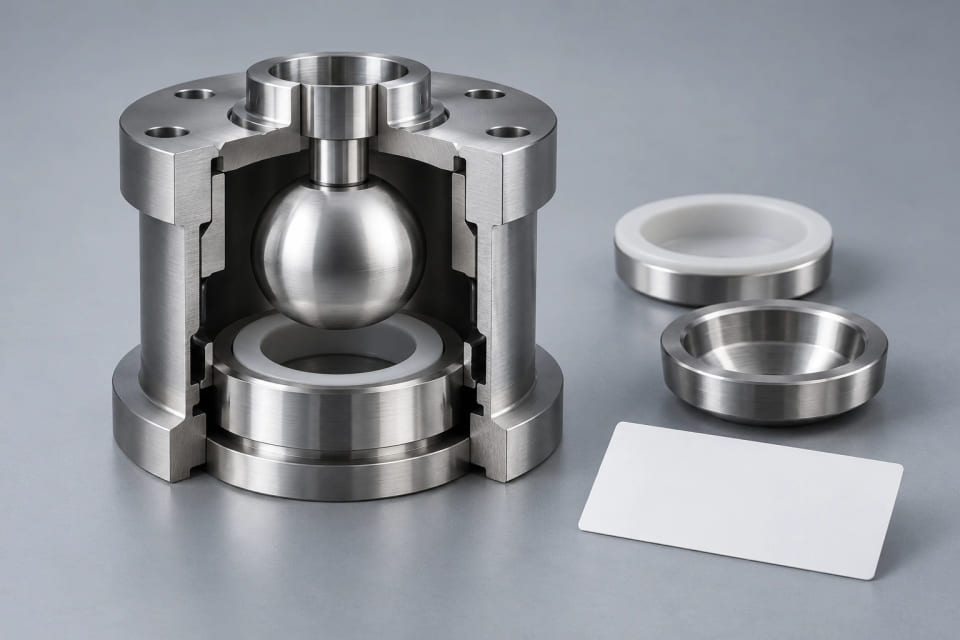
Keep each candidate and its evaluation reference identifiable. CGI illustration.
02 / IN CONTEXT
Make the Evaluation Representative of the Intended Application
A trial's meaning depends on its conditions. For a fluid contact, record the medium, cleaner, temperature, mating seat and operating cycle. For a rolling element, record the track condition, lubricant and actual load path. For process media, identify the workpiece and relevant process context without assuming another machine's result applies. Include any preparation that changes the surface or material state. If several candidates are compared, hold the agreed variables consistent and document unavoidable differences. Choose observations or measurements that answer the trial question, rather than collect numbers without a decision basis. Inspection planning can identify the measurement evidence needed for the component, while the application owner defines the complete assembly or process acceptance and the conditions under which the conclusion remains valid.
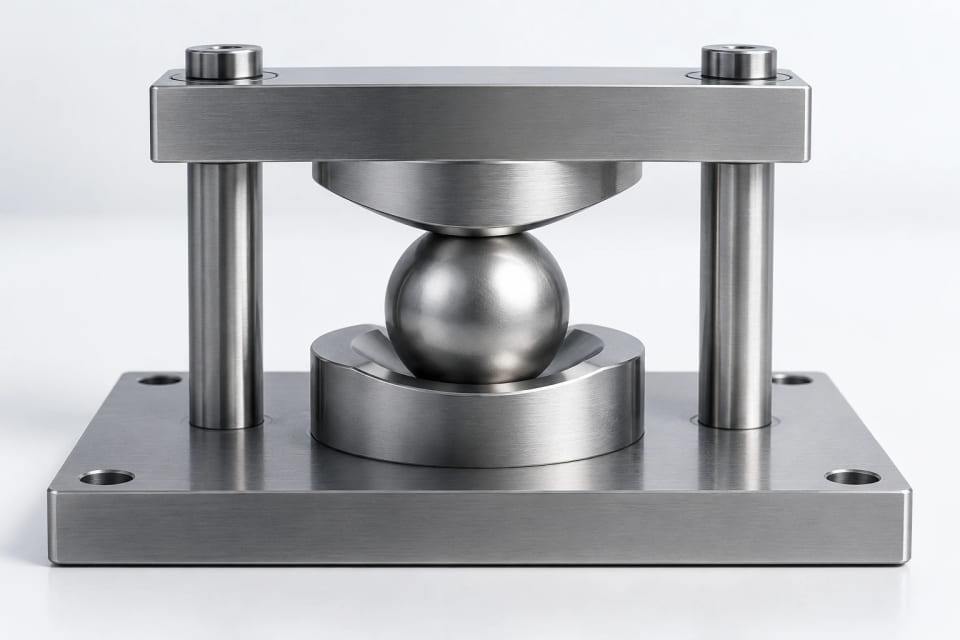
Evaluate the contact under the conditions that matter to the application. CGI concept.
03 / IN CONTEXT
Preserve the Outcome and Its Limits for the Next Order
Explicitly record the evaluated sample reference, drawing revision, material and preparation together with the test method, conditions and results. An approval should say what was accepted and identify the configuration it covers. A failure should describe the observation and the evidence needed to separate material, geometry and application causes. An inconclusive trial is still useful if it identifies the next question. Keep the sample record available when quantity, source, finish or mating parts change. A later order may need additional checks if those changes affect the original result. Use the accepted record to prepare the commercial and packaging handover, so the purchased item remains connected to the one that was evaluated rather than an informal description of a successful sample.
A SHARED REVIEW BASIS
Build the Sample Evaluation Record
Scroll the table to compare requirements →
Build the sample evaluation record
Record item
Specify before the trial
Decision it supports
Trial objective
One application or purchasing question.
Why the sample is needed.
Sample identity
Item, drawing, material and preparation.
What was actually evaluated.
Mating or process context
Seat, track, workpiece or fixture.
Where the result applies.
Test conditions
Operating sequence and relevant environment.
Whether the trial is representative.
Acceptance basis
Observation, measurement and decision owner.
How the outcome will be judged.
Next-stage record
Result, limits and changes needing review.
Whether the project can proceed.
WORKING SEQUENCE
Make the Next Conversation Specific.
01
Define the Decision
Identify the unresolved requirement and the result needed before the project can proceed. Separate an exploratory material comparison from an approval trial, and name the person or program responsible for accepting the outcome and its scope.
02
Identify the Sample Configuration
Connect the item reference, drawing revision, material and preparation with the mating parts or process context. Agree the required records and incoming checks so the trial starts with a component that represents the intended evaluated configuration.
03
Run the Agreed Evaluation
The application owner evaluates the identified sample under the recorded conditions and acceptance method. Preserve relevant observations and measurements, including any departure from the plan, so the result can be interpreted rather than reduced to an unexplained pass label.
04
Record the Next Action
Document acceptance, failure or the remaining uncertainty. Identify any changes that require renewed review and carry the evaluated item and evidence into the next enquiry, commercial handover or focused trial instead of restarting from a generic sample description.
PRACTICAL ANSWERS
Questions Before the Next Step.
Does Receiving a Sample Count as Product Approval?
No. Receipt establishes that a sample arrived, not that it met the application. Identify its configuration and the evaluation it must complete. A useful approval connects material, drawing and test conditions with the result and the owner responsible for accepting that specific component or assembly.
Can One Successful Operation Establish Long-Term Suitability?
Not by itself. The result applies to the conditions and duration actually evaluated. Define the application's required acceptance and the evidence needed to support it. A brief observation can answer an initial question while leaving wear, environmental or repeatability requirements for a further agreed evaluation.
Why Separate Incoming Inspection from the Functional Trial?
Incoming checks establish whether the sample represents the specified part. A functional trial evaluates the assembly or process result. Keeping them distinct helps identify the cause of a problem and avoids treating dimensional conformity as proof of closure, motion or another complete application outcome.
How Should Two Candidate Materials Be Compared?
Use a common objective and consistent conditions, and record the exact grades, preparation and mating parts. Change the variables the comparison is intended to assess. If other conditions differ, identify them explicitly so the outcome does not attribute every observed difference to the material alone.
What Should Happen When a Sample Fails?
Record the observation, configuration and conditions before choosing a corrective action. Determine which evidence can distinguish a material issue from geometry, preparation or the surrounding application. A documented failure can narrow the problem and define a better next trial rather than prompt an unstructured substitution.
Does the Sample Result Automatically Cover Another Source or Revision?
No automatic extension should be assumed. Identify the change and determine whether it affects the evidence behind acceptance. The application owner defines the required review. Preserve the original sample record so the decision compares a concrete configuration rather than relying on a familiar product name.
BRING YOUR REQUIREMENT
Define the Question Your Sample Must Answer
Share the component, evaluation objective and intended conditions before planning the trial.