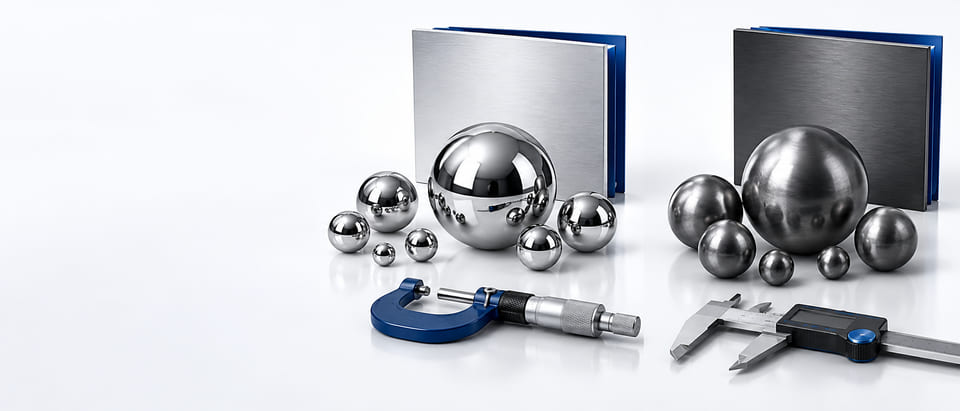
The same word can conceal two independent requirements. A buyer who separates alloy identity from precision grade can compare quotations without approving an unintended material or dimensional change.
Quick Answer: What Is Stainless Ball Grade vs Alloy Grade?
An alloy designation identifies a material, while a ball precision grade describes a specified combination of geometric, surface and sorting requirements within its governing system. AISI 316 and G100 therefore answer different questions. Neither can replace the other, and neither alone is a complete purchase specification.
Specify the exact material and condition on one axis and the finished-ball geometry and grade basis on another. Add nominal size, any required gauge or sorting information, surface requirements and the evidence needed for acceptance. MEITUO's precision steel ball category is a useful starting point for discussing both axes. This guide focuses on interpreting and correcting material-versus-precision language rather than reproducing a dimensional grade table.
Which Two Independent Requirements Are Hidden in the Word Grade?
Material language answers what the component is made from. A familiar designation such as 304 or 316 needs the applicable material specification and condition to become a controlled requirement. The designation is not a measurement of the finished sphere's diameter variation or surface geometry.
Ball-grade language answers a different set of questions. In the relevant precision-ball system, the grade combines specified dimensional, form, surface and sorting characteristics. It must be interpreted using the governing standard and edition. A number following G is not an alloy chemistry and should not be read as one.
The distinction matters because a supplier can satisfy one axis while missing the other. A sphere can have the requested alloy but unsuitable geometry. Another can meet the specified geometry while having the wrong material identity. Neither becomes acceptable simply because the purchase order used the word grade without defining which meaning it intended.
Also distinguish ball precision from other classification systems. A commercial quality class, an internal factory designation or a visual grade may not mean the same thing as a named ball standard. Ask the seller to identify its basis and describe the controlled characteristics if a familiar-looking label is used without a reference.
ISO 3290-1 addresses finished steel balls for rolling bearings. Its scope is relevant background for a precision-grade discussion, but a grade reference should be selected and applied to the actual component requirements. Do not extend a steel-bearing-ball classification to every hollow, polymer, ceramic or decorative sphere without an appropriate agreed basis.
The practical fix is simple: keep separate specification fields for material, finished condition, geometry basis, nominal size and acceptance evidence. Ambiguous language then becomes visible before it enters a quotation comparison.
How Does a Material × Precision Matrix Prevent the Wrong Substitution?
Consider four illustrative specification combinations using two material designations and two precision-grade labels. They are examples for understanding the two axes, not a MEITUO availability table or a recommendation that every combination suits an application.
| Illustrative combination | Material axis | Precision axis | What changes from the first row? |
|---|---|---|---|
| 304 / G100 | 304 requirement | G100 under an agreed basis | Reference combination |
| 304 / G1000 | Same stated alloy | Different stated ball grade | Geometry and related grade requirements |
| 316 / G100 | Different stated alloy | Same stated ball grade | Material requirement |
| 316 / G1000 | Different stated alloy | Different stated ball grade | Both independent axes |
Changing 304 to 316 does not make a G1000 sphere become G100. Changing G1000 to G100 does not supply the chemistry required by a 316 material specification. A buyer comparing quotations should mark those differences separately instead of placing all four offers in one equivalent-price column.
The matrix is also useful during a shortage discussion. A seller may propose another alloy with the same dimensional basis, or the same alloy with another precision level. Each is a distinct technical change. Engineering can then evaluate the affected requirement without assuming that improvement on one axis compensates for a miss on the other.
Once the two-axis comparison is clear, add other relevant conditions. Heat treatment, surface preparation, cleanliness and particular contact requirements may still differ between proposals that use identical alloy and grade labels. The matrix clarifies the first comparison; it does not exhaust the component specification.
Does a Precision Grade Define the Exact Ordered Diameter?
Keep nominal diameter, permissible dimensional characteristics and any required sorting or gauge information distinct. A precision label is not a substitute for the actual ordered size. Two balls can share a grade basis while having entirely different nominal diameters.
Units deserve their own check. An order for a 1/4 inch nominal sphere refers to 6.35 mm by exact unit conversion. That does not mean a supplier's nearby metric stock size is interchangeable. If the design requires the inch nominal size, preserve it and agree the controlling dimensional requirements rather than silently rounding it.
Likewise, a buyer should not treat a diameter tolerance written on a drawing as a complete precision-grade definition. Form, surface and lot-related characteristics may need separate controls. Conversely, a grade label does not eliminate the need to clarify a drawing's additional or different dimensional requirement.
Use a deliberately simplified example: a drawing gives a nominal diameter of 12.000 mm with a hypothetical permitted diameter interval of 11.990 to 12.010 mm. Two selected diameter readings of 11.996 and 12.004 mm lie inside that interval and differ by 0.008 mm, or 8 micrometres.
Those two readings do not establish full roundness, the maximum diameter variation or conformity with an entire ball grade. They are only two measurements under an unspecified sampling method. The example demonstrates why a size check and a complete precision classification cannot be treated as the same conclusion.
Ask which characteristics will be reported and how the grade conformity statement is supported. That prevents a single favorable diameter reading from being promoted into evidence for every geometric and surface requirement.
Which Quotation Phrases Should Trigger a Clarification?
Stainless grade 100 is ambiguous because it does not clearly separate material from precision. Ask whether the supplier means a ball-grade designation, an internal quality class or something else. Do not fill the missing material field from a photograph or a previous unrelated order.
AISI G100 is another warning. It combines terminology from different classification purposes without identifying a coherent requirement. Return the phrase as an open clarification and ask for separate material and precision entries. The goal is an agreed specification, not an argument about whether the shorthand is common.
Premium 316 ball is commercially descriptive but incomplete. It may identify an intended material family without defining the finished geometry. Equally, G100 stainless leaves material and condition unresolved. Both phrases need expansion before they can support a repeatable procurement decision.
| Ambiguous wording | Unresolved question | Requested correction |
|---|---|---|
| Stainless grade 100 | Material or precision? | Separate exact alloy and grade basis |
| G100 stainless | Which material and condition? | State controlled material requirement |
| Premium 316 | Which geometry and surface requirements? | State size, grade basis and extra controls |
| Equivalent grade | Equivalent on which axis? | List each proposed difference explicitly |
Apply the same check to item descriptions in enterprise purchasing systems. A short item field can remain concise if it links to a controlled specification. It becomes risky when the short field is the only technical definition and several buyers interpret the same word differently.
Document the supplier's clarification in the quotation or revised specification, not only in a phone conversation. The corrected fields should be the ones used for subsequent production and receiving records.
Which Evidence Supports Alloy Identity and Which Supports Ball Grade?
Material evidence can include the agreed certificate chain and suitable analytical results. Its scope depends on the reported material, method and connection to the delivered lot. An upstream certificate may support chemistry without establishing every finished-ball characteristic.
Geometry evidence can include the relevant dimensional, form, surface and sorting examinations required by the agreed grade and drawing. Ask which measurements were made and which population the results represent. A document with the correct alloy heading does not establish that those measurements were completed.
Keep the reports connected through component and lot identity. Separate material and dimensional PDFs are useful only when the buyer can determine which delivered item each supports. A coherent evidence package can contain several original documents; it does not need to pretend that one laboratory or supplier performed every activity.
If a dimensional result is acceptable but alloy identity remains unresolved, describe that as a partial finding. If material identity is supported but the ball-grade basis is unclear, keep that precision question open. A single overall green status can conceal exactly the distinction the two-axis system is meant to preserve.
For formal acceptance, define the applicable methods, sampling and decision rules within the controlling specification or procedure. A marketing article cannot replace those requirements. The quality and inspection page provides an enquiry route for discussing which component records are needed.
How Should Buyers Write an Unambiguous Two-Axis RFQ?
Start with the component reference and drawing revision. State the exact alloy and material specification, required condition, nominal diameter and units. Then identify the ball precision standard and edition, grade and any additional agreed geometry, surface or sorting requirement. Keep customer-specific exceptions visible.
Ask the supplier to respond on the same axes. A structured quotation can say material proposed, precision proposed and exceptions, with a separate commercial scope. If the supplier cannot offer the requested combination, the alternative can be evaluated without losing the baseline.
Include the evidence required for both axes and how it connects to the delivered lot. Specify whether a document is required before release, with shipment or at another review point. This reduces the chance that a technically plausible offer becomes unusable because its inspection or material-record scope differs from the order.
When approving an alternative, record what actually changed. A permission to use another alloy should not implicitly authorize a different precision level, and a dimensional relaxation should not permit another material. The authorization should be narrow enough that the next purchase follows the same interpretation.
Send these fields through the MEITUO RFQ page. If an existing supplier description is ambiguous, attach it and mark the unresolved terms. A clear question at quotation is less disruptive than discovering during assembly that the buyer and seller used grade to mean different things.
A useful RFQ response can be checked with a two-column exception log. In the material column, record a changed designation, condition or material evidence scope. In the precision column, record a changed standard, grade, nominal size, gauge or additional geometric requirement. Add a third note for changes that affect both, such as a different process route offered with a different finished condition and geometry. This keeps an apparently minor commercial alternative from concealing several technical changes.
For example, if a seller quotes the requested 316 material but a different ball precision basis, keep material as proposed unchanged and precision as deviation awaiting review. Do not rewrite the whole offer as equivalent stainless. If another seller offers the requested precision with a different alloy, make the opposite entry. The comparison then reveals exactly which engineering decision each quotation requires.
After clarification, update the controlled item record or attachment used for purchasing. A corrected quotation can still fail operationally if the purchase order is generated from an older short description. The receiving plan should point to the approved material and precision fields so the resolved language survives the transition from enquiry to order.
How Can China and Italian Supplier Comparisons Use the Same Grade Language?
China: Qingdao, Shandong
For a China-based enquiry to MEITUO Balls, place the alloy and precision basis in separate fields. Supply both the original drawing terminology and any proposed translation. Ask the quotation to identify deviations explicitly so a regional material name or factory quality label does not quietly replace the controlled requirement.
Italy: Cinisello Balsamo, Milan area
RGPBALLS publishes precision-ball categories covering several material families from Cinisello Balsamo. It provides a relevant Italian supplier example for comparing material and precision language. Confirm the actual proposed combination, standard basis and finished-component evidence; a broad catalogue range does not establish availability of every alloy-and-grade pair.
Across markets, preserve the controlling technical reference while allowing practical bilingual communication. The object is a comparable component proposal, not a forced conversion of every supplier's internal terminology into an unsupported equivalence.
How Can MEITUO Balls Clarify Material and Precision Requirements?
MEITUO Balls is the industrial-ball website of Qingdao Meituo Steel Co., Ltd., based in Qingdao, China. Its company profile presents a specialty-steel background and an enquiry scope covering multiple ball-material families. That material breadth makes a clear distinction between alloy identity and finished geometry particularly useful.
Send your exact material requirement and precision basis together with the ball size, drawing revision, application and quantity. If you have an existing description such as stainless grade 100, include it as a question rather than turning it into a new assumed specification. MEITUO can review the requested scope and clarify what information a component proposal needs.
Use the steel ball product family for the material discussion and the inspection route for the evidence discussion. A published category is not a promise of every material-grade combination, certificate or inventory position. Confirm the exact proposed component and any deviations in the actual quotation before the engineering owner approves the purchase.
Stainless Ball Grade vs Alloy Grade FAQ: What Should Buyers Ask?
Is AISI 316 a ball precision grade?
No. It identifies an alloy designation within the material requirement. The finished sphere still needs size, geometry, surface and any applicable precision-grade requirements to be specified separately.
Does G100 mean a particular stainless alloy?
No. A ball-grade label belongs to a precision classification under an agreed basis. State the exact material and condition independently; stainless alone does not identify every required material detail.
Can a better precision grade compensate for the wrong alloy?
No. The two axes address different requirements. An alternative must be reviewed against the affected material and application criteria even if its geometry is more tightly controlled.
Does a diameter reading prove complete grade conformity?
Not by itself. A grade may involve several dimensional, form, surface and sorting characteristics. Evidence must address the requirements of the actual governing basis rather than one selected reading.
What should an ambiguous quotation say instead?
Request separate entries for material designation and specification, condition, nominal size and units, precision standard and grade, additional requirements and deviations. Preserve the agreed correction in the quotation record.
Does a catalogue confirm every material-and-grade combination?
No. A product range is a starting point for an enquiry. Confirm feasibility, evidence and the exact proposed combination for the actual diameter, quantity and application.