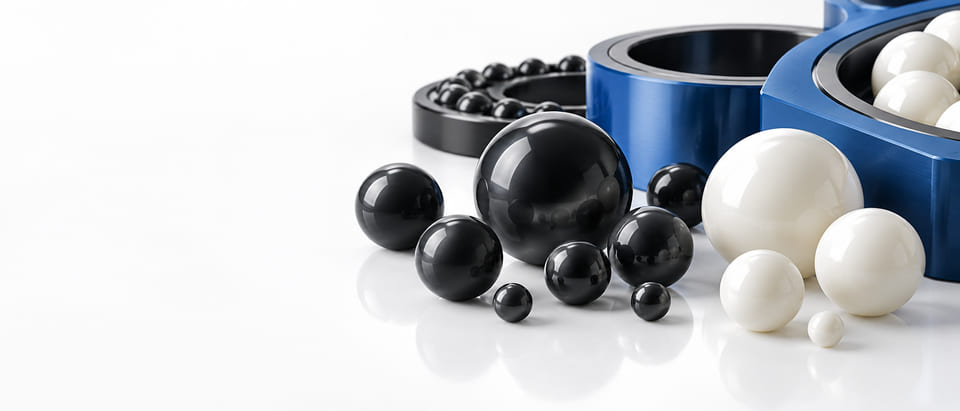
Choosing between silicon nitride and zirconia starts with the mechanism. The same sphere diameter can conceal a different mass, contact response and validation requirement, so a material comparison must remain connected to the complete component.
Quick Answer: How Should Buyers Choose Silicon Nitride vs Zirconia Balls?
Define the function and compare exact material grades under the same geometric and operating requirements. Consider mass, contact, damage risk, chemical and thermal exposure, then validate the complete bearing, valve or process. Neither ceramic family is a universal upgrade. Keep material identity, ball precision and assembly performance as separate acceptance questions.
MEITUO Balls can use these questions to review a defined component enquiry. Begin with the relevant product or application guide, then identify the conditions that your drawing does not yet resolve.
Which Properties Distinguish Silicon Nitride from Zirconia Balls?
Silicon nitride and zirconia are different ceramic material families, not two color options for the same sphere. Exact composition, microstructure, processing and inspection requirements matter. A comparison should identify the proposed grades before assigning numerical properties or drawing conclusions about a finished component.
Mass is one useful starting point. Zirconia is generally denser than silicon nitride, so equal-diameter balls can interact differently with a moving mechanism or liquid. That distinction can influence the engineering question without deciding the entire application. Stiffness, contact behavior, surface condition and damage tolerance also need review against the actual system.
Keep material properties separate from ball geometry. A high-performance ceramic still needs the appropriate diameter, form and surface acceptance. A precise sphere of the wrong material can be unsuitable, while a promising ceramic family does not establish that the offered finished ball meets the drawing. Request evidence at the level the component requires.
Do not extend a family description into an unrestricted claim. Electrical behavior, chemical resistance and thermal response should be checked for the exact proposed grade and conditions. In particular, describing every ceramic as an electrical insulator is incorrect; the broader ceramic category contains materials with different behavior. State the required electrical result if that property is important to the design.
| Selection question | Silicon nitride candidate | Zirconia candidate |
|---|---|---|
| Moving mass | Often considered when lower mass is useful | Different density changes equal-size behavior |
| Contact and damage | Review exact grade and contact evidence | Review exact grade and contact evidence |
| Acceptance | Geometry and surface remain explicit | Geometry and surface remain explicit |
Silicon Nitride vs Zirconia: What Changes in Bearings and Valves?
The function changes the comparison. In a bearing, the ball interacts with raceways, cage, lubricant, preload and operating conditions. In a check valve, it interacts with a seat, fluid, installation orientation and closing cycle. A material that is attractive for one mechanism may introduce an unwanted change in the other.
For rolling contact, ask which requirement motivates the ceramic: mass, electrical behavior, temperature, corrosion or another constraint. Evaluate the complete bearing rather than treating loose balls as a universally interchangeable upgrade. An existing steel-ball arrangement may require different internal design decisions when another material is proposed.
For fluid control, identify whether ball weight contributes to closing or movement. A same-size substitution can change buoyancy or response even when the ball still fits the housing. The seat must be compatible with the new contact. Particles, impact and fluid properties can affect the pair independently of a catalogue comparison of hardness.
Keep the commercial description precise. Silicon nitride bearing balls, zirconia check balls and ceramic grinding media may all be spherical, but they are not the same procurement item. Their acceptance characteristics and validation needs differ. A supplier should know the component function before suggesting a material, and the buyer should not approve an offer solely because the listed ceramic is familiar.
| Mechanism | Relevant comparison | Validation result |
|---|---|---|
| Bearing | Ball, race, cage, preload and lubrication | Accepted assembled running behavior |
| Check valve | Mass, seat, medium and closure | Leakage and reopening under defined duty |
| Process media | Purity, wear and equipment | Accepted product and process outcome |
An important purchasing distinction is the difference between a ceramic grinding bead and a precision rolling or sealing ball. Even if the chemistry appears similar, a process-media offer may use another size-distribution, surface or defect acceptance basis. State the finished-component requirements instead of asking the supplier to infer them from the word zirconia.
If the enquiry begins with an existing sample, record its known use and condition. A worn sphere can support investigation, but it cannot reveal the original grade, surface acceptance or operating history by itself. Material analysis and geometry measurements answer different questions. Identify which unknowns need resolving before the replacement can be specified. This prevents a reverse-engineered diameter from becoming an unsupported declaration that the complete original requirement has been reproduced.
How Should Density Be Connected with the Actual Design?
Density is useful only when the calculation and its assumptions are visible. For an illustrative comparison, suppose two offered materials have stated densities of 3.2 and 6.0 g/cm³ and both spheres have a 10 mm diameter. The sphere volume is approximately 0.5236 cm³. Their calculated masses would be approximately 1.68 and 3.14 g. These are hypothetical supplier inputs used to demonstrate the method, not guaranteed properties of every silicon nitride or zirconia ball.
In a liquid, consider displaced-fluid mass as well as ball mass. The resulting buoyancy relationship can change the effective closing contribution of gravity. It does not alone determine valve dynamics, because flow, viscosity, orientation, pressure differential and contact geometry also matter. Verify the mechanism rather than presenting a density calculation as a performance prediction.
For a moving assembly, mass can influence response, but a lower value is not automatically the desired outcome. Some mechanisms rely on a specified weight or force balance. Record why mass matters and which change is permitted before choosing the apparently lighter option.
Use actual proposed material data when making the real design calculation. If density is critical, define an appropriate verification method and its uncertainty. A measured mass can help check consistency, but it does not independently prove composition, microstructure, surface quality or the absence of defects.
The purchasing worksheet should keep material identity, density source, diameter, calculated volume and mass, actual measured mass and functional acceptance in separate fields. Do not hide an assumed material value inside a spreadsheet formula that later becomes a drawing requirement.
What Should Buyers Ask About Wear, Chipping and Surface Defects?
Hardness does not remove the need to assess brittle damage. Impacts during assembly, contact with an unsuitable edge or damage during transport can be important even where a ceramic resists wear in normal operation. Inspect the way the sphere is handled and loaded, not only its published material properties.
Define relevant surface acceptance. A scratch, pit or chip may have different consequences depending on whether it lies in a rolling contact, sealing region or nonfunctional area. Agree an inspection method, lighting, magnification and defect criteria. A product photograph or a bright polished appearance is not a complete surface report.
For wear trials, use the real mating material and environment where practical. Record load, movement, lubricant or fluid, temperature and the observed failure mode. A comparison performed against a different counterface may not explain the installed assembly. Keep specimen preparation and cleaning consistent so residues do not distort mass-loss or surface observations.
Preserve damaged samples and their identities. If chips appear after delivery, inspect packing, handling and assembly history before assigning a cause. Do not mix suspect and accepted lots. Where a nondestructive method is requested, define the defects it can detect and the limits of that detection rather than treating the presence of a test certificate as proof that every possible flaw is absent.
Request examples of the actual inspection record and the agreed response to nonconforming material. If the consequence of a broken sphere is severe, the equipment owner should establish the corresponding design, qualification and containment requirements. A loose-ball supplier cannot determine those responsibilities from diameter alone.
How Should Chemical and Thermal Exposure Be Qualified?
A ceramic family name is not a complete chemical-compatibility specification. Record the process medium, concentration, temperature, cleaning fluids and exposure sequence. Consider the exact material proposal and any constituents relevant to the intended application. An unchanged short-term appearance does not demonstrate unlimited resistance.
Thermal evaluation should describe how temperature changes, not just the highest value. Heating and cooling rate, local gradients, contact constraint and repeated cycles can matter. A loose sphere in a uniform environment does not necessarily represent a ball held tightly in an assembly made from another material.
Use controlled comparisons to identify the question being answered. A chemical screening test can reveal a material response, while a full assembly test can reveal contact or fit changes after exposure. Keep those conclusions distinct. Do not combine separate datasheet advantages into a claim that the component has already passed the combined duty.
Where cleanliness or regulated contact is important, establish the required evidence for the finished component and intended use. A general statement about ceramic purity does not demonstrate compliance, absence of contamination or suitability for every process. Identify the documentation owner, test scope and acceptance decision before requesting samples so the study produces useful evidence rather than an attractive but incomplete report.
A practical trial records material grade, ball and mating-part IDs, initial geometry, chemical preparation, temperature profile, cycle history, post-exposure inspection and functional result. If a test is interrupted or a fluid is replaced, retain that event in the record.
How Can an OEM Make the Final Ceramic Ball Purchase Decision?
Choose the material that meets the defined duty with an acceptable evidence and supply basis. Compare exact proposals under the same drawing and functional test. If the two offers use different ceramic grades, geometry conventions or report scopes, resolve those differences before comparing price.
Separate the sample objective from production release. A small trial can demonstrate fit or one operating condition without establishing all of the buyer's required life, environmental and documentation conditions. Record what passed, what remains open and who can approve the next stage. Retain a reference sample if the program needs one.
For recurring supply, define change control. A material grade, source, process or inspection change may require review even when the product name is unchanged. Preserve lot identity through packaging and receiving, and agree how fragile components will be protected and inspected after transport.
Include the cost of qualification and potential failure in the purchasing comparison. A nominally cheaper ball may require more testing, while a more expensive ceramic may offer no useful advantage against the actual limiting requirement. An evidence-led decision records why silicon nitride or zirconia was selected, which alternatives were rejected and the conditions under which that decision remains valid.
An effective RFQ provides the function, exact material requirement or candidate comparison, diameter and geometric limits, mating component, exposure, quantities, inspection needs and destination. Attach the known failure history if replacing a current part. The specific question matters more than a broad request for premium ceramic balls.
Which Suppliers and Local Purchasing Questions Matter for This Project?
The following supplier examples connect component sourcing with practical receiving and qualification questions. They are research starting points rather than a ranking. The proposed product, size, documentation and commercial scope should be confirmed directly for the actual purchase. Keep the same technical acceptance basis when comparing quotations from different locations.
China: Qingdao, Shandong
MEITUO Balls in Qingdao provides a China-based enquiry route for ceramic-ball requirements. Identify whether the request concerns a rolling element, sealing sphere or process medium. Provide the exact material grade if fixed, and describe the validation question if comparing candidates. Confirm source, geometric acceptance, inspection and sample scope for the actual item. A product-family listing is a starting route, not an assurance that all ceramic materials, sizes and records are interchangeable.
Italy: Cinisello Balsamo, Milan
RGPBALLS publishes separate silicon nitride and zirconium oxide ball references from its Italian base. Those distinct references support a material comparison but do not establish a MEITUO specification or qualify the buyer’s assembly. When comparing an Italian offer with a China-based route, align material identity, surface and dimensional requirements, packaging and the intended application test. Ask for the current offered grade and documents directly, rather than translating a general catalogue advantage into an unlimited performance commitment.
Compare offers using the same duty and acceptance requirements. An office address or familiar material name does not establish local stock, approved application performance or interchangeable supply. Keep the legal seller, source responsibilities and drawing revision identifiable. The choice between a domestic and international route should consider the cost of qualification, communication, inspection and replenishment as well as the first unit price.
How Can MEITUO Balls Support a Specification-Led Enquiry?
MEITUO Balls is the ball-focused website of Qingdao Meituo Steel Co., Ltd., in Qingdao, China. Its published company profile describes a specialty-steel background and a component-focused purchasing conversation. The source, processing, inspection and supply responsibilities are established for the particular component enquiry. Discuss any manufacturing-source or laboratory requirements with the proposed order so the documented scope answers your supplier-qualification questions.
For a silicon nitride versus zirconia comparison, send the specific decision you need to make, not simply a request for the best material. Include the current drawing, operating conditions, expected quantities and the evidence that will allow your team to approve the next step. Identify which requirements are fixed and which alternatives may be proposed. MEITUO can be included in that review without treating a catalogue description as finished-component qualification.
Explore the relevant component guide and sampling and validation route. Confirm technical acceptance and commercial terms in the quotation before committing to an order or changing an approved material.
Silicon Nitride vs Zirconia Balls FAQ: What Should Buyers Ask?
Is silicon nitride always better than zirconia?
No. They are different material families, and the better choice depends on the mechanism and exact grades. Review moving mass, contact, exposure, geometry and acceptance rather than applying a universal ranking to two ceramic names.
Can equal-size ceramic balls be swapped directly?
Not without review. Different mass, contact behavior and material response can change the assembly. Preserve the drawing requirements and validate the relevant bearing, valve or process function before accepting a substitution.
Does a ceramic ball automatically provide electrical insulation?
No universal assumption should be made across ceramics. Specify the required electrical behavior for the exact material grade and operating conditions, and obtain suitable evidence. A generic ceramic description is not an electrical qualification.
Does high hardness prevent ceramic-ball chipping?
No. Handling, edge contact and impact can still cause damage. Establish suitable surface acceptance, packaging and assembly practices. Evaluate the actual failure consequence and inspection capability rather than relying on hardness alone.
Can density identify a ceramic grade?
A suitable density or mass check can support consistency assessment but does not independently prove complete composition, microstructure or quality. Keep the material identity and required inspection evidence separate from a simple calculated weight.
What should MEITUO receive for a ceramic comparison?
Send the function, ball and mating-part geometry, exact materials under consideration, exposure and acceptance objective. Include sample and production quantities, required records and any current failure data so the comparison addresses a specific purchasing decision.