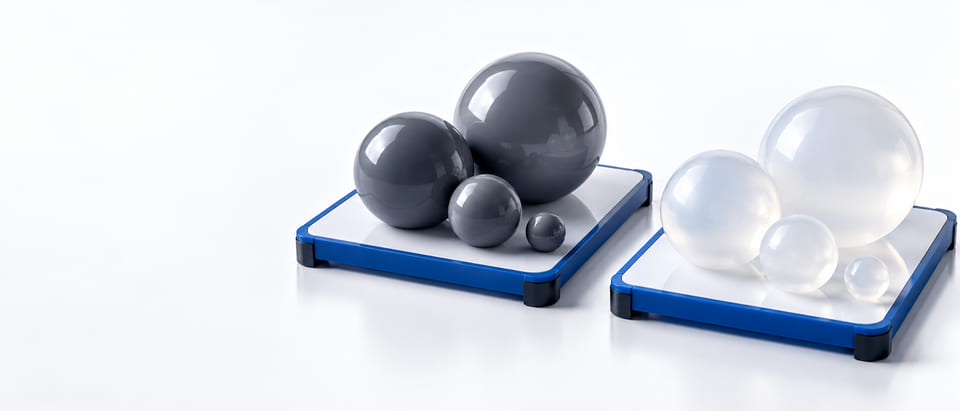
PVC-versus-PP selection begins by identifying what each material name actually means. This guide connects formulation, fluid forces and thermal contact with the tests an industrial buyer needs before approving a change.
Quick Answer: PVC vs PP Balls—Which Material Description Comes First?
Before comparing PVC with PP, establish whether PVC means rigid unplasticized material or a flexible plasticized formulation, and whether PP means a specified homopolymer or copolymer grade. These are not minor details. They can change stiffness, density, contact deformation, chemical response and the documentation needed for the finished ball.
A rigid PVC ball and a low-density PP ball can support very different motion in a fluid system. A flexible PVC sphere introduces another set of sealing and recovery questions. Choose the route around the actual liquid, temperature cycle, contact load and required movement rather than assuming one plastic is universally better for chemicals.
For a MEITUO PVC ball enquiry, name the intended formulation type and compare it with a defined PP candidate. Include the seat and orientation. Equal nominal size does not preserve the closing force, contact behavior or fluid compatibility when the material changes.
Why Is Rigid PVC vs Flexible PVC a Critical Distinction?
PVC is a formulation platform, not a single stiffness level. Unplasticized PVC, often identified as PVC-U in industrial systems, differs from flexible PVC containing a plasticizer package. Stabilizers, pigments and other additives also influence the final compound. The word vinyl does not resolve which finished material is being proposed.
A flexible formulation may deform and recover differently at a seat than a rigid one. Its long-duration contact, rebound and potential interaction between additives and the process medium require appropriate review. This does not mean all flexible PVC is unsuitable; it means a rigid-PVC assumption cannot support its application approval.
PP also needs an exact description. Homopolymer, random or impact-copolymer directions can provide different balances, and fillers or modifiers can change the result further. A natural PP ball and a filled colored compound should not share one unqualified validation record merely because both are polypropylene.
Ask for the offered compound’s identity and the scope of supporting documents. If the buyer requires a rigid ball, say so explicitly. If compliance depends on a particular formulation, do not permit an unnamed equivalent without review. The formulation is part of the engineering definition, not an incidental purchasing detail.
Avoid using appearance as identification. Rigid and flexible materials can be colored similarly, and transparency or gloss can be affected by processing. Physical inspection can reveal an obvious mismatch, but a squeeze test or color comparison is not reliable proof of the exact resin and additive package.
PVC vs PP Balls: Which Differences Affect an Industrial Fluid System?
Compare the materials as completed components. Rigid PVC often presents a different density and stiffness balance from unfilled PP, while flexible PVC requires its own treatment. Chemical suitability depends on the exact compounds and exposure. A piping-system material guide is useful context, but its pressure or temperature rating is not a loose ball’s rating.
| Requirement | Rigid PVC route | PP route | Do not overlook |
|---|---|---|---|
| Material identity | PVC-U or exact rigid formulation | Exact homopolymer or copolymer | Flexible PVC is a separate proposal |
| Gravity and buoyancy | Verify relatively dense compound and mass | Verify low-density compound and mass | Actual liquid density and orientation |
| Contact behavior | Check rigid-component response and damage | Check stiffness, creep and recovery | Seat edge, dwell and temperature |
| Chemical exposure | Exact PVC formulation in mixture | Exact PP grade in mixture | Cleaners, stress and repeated cycles |
| Thermal duty | Review component response, not pipe rating | Review component response, not melting point | Housing expansion and running clearance |
| Documentation | Formulation-specific evidence | Grade- and additive-specific evidence | Finished-part scope and jurisdiction |
The density difference can be useful when the device needs a sinking element, but it can be harmful if the design expects buoyant return. The stiffness difference can affect contact, but a stiffer candidate is not automatically a better seal. Identify the required action first.
For a substitution, inspect the existing seat and guide rather than treating them as neutral fixtures. A geometry developed for one compound can create excessive local stress or friction with another. Compare the complete interface and record any assembly change alongside the material change.
How Can PVC vs PP Reverse Gravity-Closing Behavior? A Hypothetical Example
Assume a solid 12 mm ball, giving a volume of π/6 × 1.2³ = 0.9048 cm³. Use deliberately hypothetical compound densities of 1.40 g/cm³ and 0.91 g/cm³, with a liquid density of 1.05 g/cm³. These values teach the calculation; they are not specified PVC or PP properties and do not describe MEITUO samples.
The two calculated ball masses are approximately 1.2667 g and 0.8233 g. The fully submerged displaced-liquid mass is 0.9500 g. The denser candidate therefore has a downward mass-equivalent margin of about 0.3167 g, while the lighter candidate has an upward margin of about 0.1267 g. Their static tendencies oppose each other despite equal diameter.
A gravity-closing valve could therefore respond very differently to the change. That does not establish actual closure performance: pressure forces, spring force, flow and guide contact remain outside the calculation. It identifies why a nominally equivalent lightweight alternative deserves an assembly review rather than automatic substitution.
If the intended mechanism needs a reliable downward margin across several fluids, repeat the calculation at the highest relevant fluid density and the lightest accepted complete ball. For upward action, use the opposite limiting direction. Consider actual sample distributions instead of mixing convenient nominal values from unrelated conditions.
Do not label the mass difference itself as a force in newtons. Convert grams to kilograms and multiply by gravitational acceleration when a force comparison is needed. Keep the simplified worksheet separate from the full valve force model, which must account for pressure acting on the relevant effective area.
How Should Chemical Resistance and Additive Questions Be Evaluated?
Describe the actual mixture rather than one headline ingredient. Concentration, temperature, exposure time, oxidizers, solvents and cleaning residues can change the outcome. General chemical-resistance charts should guide the shortlist and test conditions; they do not approve a finished PVC or PP ball for every formulation of an industrial liquid.
For PVC, ask whether the supporting information covers the proposed rigid or flexible compound. In a plasticized material, the additive package can be relevant to fluid interaction and regulated-contact documentation. Do not infer migration or extractables performance from the polymer-family name. For PP, ask the same grade-specific questions about pigments, modifiers and other additives.
Run exposed samples with relevant mechanical stress where that reflects service. An unstressed soak may not reproduce a ball held against a seat or squeezed during assembly. Record cracks, dimensional movement, mass changes, surface condition and the functional result. If deposits form, investigate them separately from degradation of the base material.
Include the partner materials. A ball that tolerates a cleaning agent cannot make an incompatible housing, seat or gasket suitable. Conversely, leakage after cleaning may originate in another part rather than the sphere. Inspect the complete interface before declaring a PVC-versus-PP winner.
Where the process has a formal contact requirement, identify the jurisdiction and intended use early. Request evidence for the actual offered compound and finished-part scope. A familiar material used elsewhere in water or food equipment does not automatically satisfy the requirements of a new device or market.
Separate bulk compatibility from process contamination requirements. A sphere can retain its dimensions and still require evidence about substances transferred to a sensitive product stream. Conversely, a visible film may come from the process liquid rather than from the ball. Choose analytical or cleanliness checks according to the actual risk and required standard, not an assumed conclusion about the polymer.
If a supplier changes a pigment or stabilizer while preserving the base resin name, review whether the existing documents and trial remain representative. The appropriate response depends on what changed and what the device controls; it is not automatically a full redesign, but it should not be silently ignored.
Why Should Pipe Ratings and Resin Melting Points Stay Out of Ball Load Claims?
Industrial PVC-U piping documentation describes a particular system with its own geometry, joints and pressure-temperature basis. It can illustrate the importance of temperature and material selection, but it does not give a free ball an allowable pressure. Similarly, a PP melting point does not define acceptable deformation under a long-duration seat load.
Write the ball’s actual duty: fluid temperature, pressure differential, contact geometry, closed dwell and required recovery. A narrow seat can impose concentrated contact that differs greatly from a pipe wall’s stress state. Evaluate leakage and restart after representative dwell rather than relying only on an intact appearance.
Thermal movement can alter the guide clearance. The ball and housing may expand differently, and a warm polymer can also be less stiff. These effects can act together: a reduced clearance increases rubbing just as the surface becomes more susceptible to marking. Test the assembly through the relevant cycle, including startup and cooling.
Cold operation and handling impact deserve separate attention. A candidate that works in a warm chemical line may behave differently during cold transport or assembly. Use actual grade guidance and representative events rather than ranking the entire PVC and PP families with a single brittle-or-tough label.
Keep exposure and recovery measurements distinct. A temporary size change at operating temperature may be acceptable if the assembly is designed for it; a lasting contact impression may not be. State when dimensions and function are evaluated so the test can distinguish reversible thermal movement from damage or time-dependent deformation.
What Should an OEM Compare Before Switching Between PVC and PP?
Begin with two identified formulations and representative finished spheres. Measure mass, diameter, relevant form and functional surface under the same agreed condition. Record rigid or flexible PVC explicitly. If the candidates differ in processing route as well as material, keep both variables visible in the test report.
Use the actual seat, guide and orientation. Measure opening and closing separately and include low-flow or startup behavior if relevant. A ball can close acceptably under a strong pressure differential while failing to return under weak gravity or buoyancy. The most demanding event may occur outside normal steady operation.
Add the actual cleaning sequence, prolonged dwell and representative contamination. Inspect the contact band and partner surface after each relevant stage. Do not assume a smooth polished sample represents a freely rotating production sphere with a local witness unless the final surface condition is equivalent.
Define what counts as an acceptable change. A visual mark may be cosmetic, a change in mass may be residue, and a small dimensional movement may be critical to a narrow guide. Link each observation to a functional criterion rather than treating every difference as failure or ignoring every nonleaking defect.
Use sample validation planning to identify the evidence needed before recurring orders. Preserve compound identity in the approved specification and require review of relevant formulation changes. This keeps a useful comparison from becoming an uncontrolled rigid-to-flexible or homopolymer-to-copolymer substitution later.
Where Can Buyers Research PVC and PP Ball Supply Routes?
China
In China, MEITUO in Qingdao can review a formulation-specific PVC-versus-PP enquiry. Buyers searching for PVC ball suppliers in China should state rigid or flexible material before discussing dimensional requirements. For a PP alternative, name the grade or explain that it is open for technical selection.
Provide the closing direction, liquid-density range and cleaning sequence to both the China sourcing contact and the responsible design engineer. This prevents a quotation based on appearance and diameter from being mistaken for a technically equivalent fluid component.
France
Marteau & Lemarié in Sorbiers publishes industrial plastic balls and lists polypropylene among its materials. It is a relevant French supplier research example for the PP route; a particular PVC formulation would need a specific enquiry and confirmation. Do not treat a broad plastic range as proof of every resin option.
For French industrial buyers, compare the same finished material and surface scope across France and China proposals. Ask which chemical and functional questions remain with the OEM. A local distributor’s range can simplify sourcing research without replacing formulation-specific acceptance.
United States
Engineering Laboratories in Oakland, New Jersey, publicly lists PP balls, PVC balls and flexible PVC products in separate categories. That distinction is useful for a US sourcing investigation because it makes formulation type visible. Exact compound, size and current supply still need confirmation for the actual order.
A US-versus-China comparison should retain the rigid/flexible distinction and the same functional test. Ask whether the samples and later production share the identified formulation. Compare complete accepted output and documentation, rather than assuming all products under the PVC heading have the same fluid-system behavior.
How Can MEITUO Review a PVC or PP Fluid-Component Requirement?
MEITUO Balls is associated with Qingdao Meituo Steel Co., Ltd., based in Qingdao, China. A meaningful enquiry for this topic describes a formulation and a mechanism together. Rigid chemical-handling ball, flexible sealing element and buoyant PP component are different development questions, even when their nominal diameters match.
Send the drawing, material restriction or permitted alternatives, fluid composition, density range, cleaning process, temperatures and quantities to [email protected]. Include the active contact surface and any regulated-contact documentation requirement. If a current ball has failed, explain whether it stuck, leaked, cracked or changed appearance and when that occurred.
Use the PVC ball page and PP ball page to identify the requested routes. Exact formulation, supply and performance remain subjects for review and testing. The goal is a clear candidate and validation plan, not a universal chemical-resistance claim based on a polymer abbreviation.
PVC vs PP Balls FAQ: What Should Buyers Ask?
Is PVC always a rigid material?
No. Rigid unplasticized PVC and flexible plasticized PVC are different formulation routes. State which is intended and identify the actual compound.
Will a PP ball replace a PVC ball at equal diameter?
Not automatically. Density, stiffness, contact response and chemical behavior can change the mechanism. Review orientation and validate the actual assembly.
Can PVC pipe pressure ratings be applied to loose balls?
No. Those ratings concern a defined piping system and geometry. A ball requires its own component and assembly review.
Does PP melting point establish its working temperature?
No. Sustained load, contact geometry, duration and acceptable deformation determine the relevant service response. Melting point alone does not answer that question.
Why do additives matter for a fluid component?
They can affect mechanical response, fluid interaction, appearance and documentation. Evidence should cover the actual formulation rather than only the base polymer.
What do the opposite margins in the example show?
They show how equal-size hypothetical balls can tend in opposite directions in one liquid. The example is not material data or proof of actual valve closure.