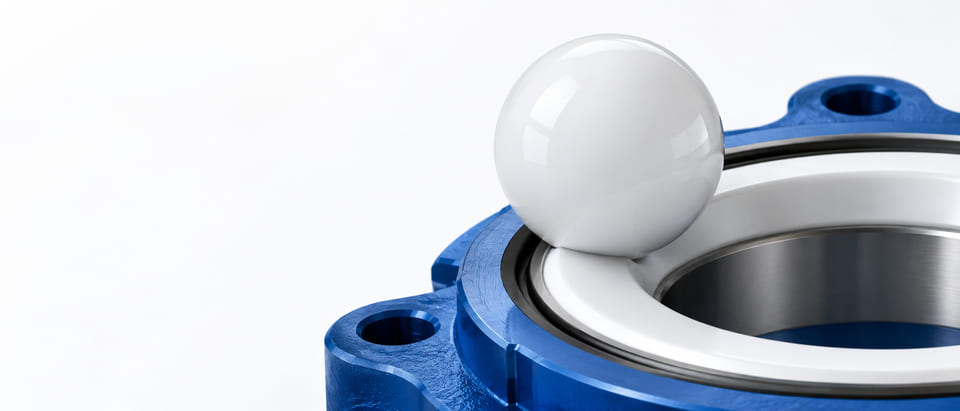
PTFE can solve one material-selection problem while leaving a contact-design problem unresolved. A useful sealing study examines time under load, the mating seat and the actual acceptance result, rather than treating chemical resistance as proof of service life.
Quick Answer: How Should PTFE Ball Creep Be Evaluated for Sealing?
Evaluate the exact PTFE formulation in a defined ball-and-seat contact under relevant load, temperature, fluid and dwell conditions. Measure the required leakage and reopening results as well as dimensional or surface change. Use suitable controls to distinguish deformation from wear, particles or chemical effects. A short bench test supports only its stated decision; it does not prove unlimited service life.
MEITUO Balls can use these questions to review a defined component enquiry. Begin with the relevant product or application guide, then identify the conditions that your drawing does not yet resolve.
Why Can a Chemically Resistant PTFE Ball Still Develop Leakage?
Chemical resistance and dimensional stability under load are separate requirements. PTFE may be considered for difficult fluid contact, but an acceptable chemical response does not establish that a seated sphere will retain its geometry indefinitely. The actual resin, construction, contact force, temperature and dwell history govern the question being tested.
In a closed valve, load is concentrated around a contact region rather than distributed uniformly through an unconstrained specimen. The ball and seat can deform, contamination can enter the sealing interface and operating cycles can damage surfaces. A growing leak therefore requires investigation of the pair and its environment. It should not automatically be called creep merely because the ball is PTFE.
Define the symptom carefully. Does leakage appear during a long closed dwell, after repeated reopening or only after cleaning? Does the mechanism recover when load is removed? Is the seat damaged or the ball permanently marked? These observations help choose an experiment, but they are not substitutes for a controlled comparison. Preserve the failed pair and its orientation where practical.
Begin with the component drawing and the operating cycle. If the specification only says chemical-resistant ball, important mechanical acceptance may never have been agreed. Establish the required closure behavior, permitted leakage and reopening function before asking a supplier to change the material or provide a harder-looking sphere.
| Question | Evidence | Avoid assuming |
|---|---|---|
| Chemical compatibility | Exact fluid and grade review | No visible attack proves sealing |
| Time under load | Dwell and recovery measurements | A short pass predicts unlimited life |
| Contact integrity | Ball, seat and contamination observations | All leakage is a ball-only failure |
Creep vs Wear vs Chemical Swelling: How Can Buyers Separate the Mechanisms?
Creep describes time-dependent deformation under sustained stress. Wear involves material loss or surface change associated with contact and movement. Chemical swelling involves interaction with the exposure medium. A component can experience more than one mechanism, so a single final diameter is rarely enough to separate them.
Use observations that are relevant to the suspected process. A static loaded specimen can reveal a time-dependent contact change without repeated sliding. An unloaded fluid-exposed control can help identify a material response to the medium. A cycling test introduces repeated contact and movement. Compare those conditions thoughtfully instead of attributing every difference to the same cause.
Measure more than one characteristic where the decision requires it. Contact imprint, dimensions, mass, surface appearance, leakage and reopening behavior provide different information. State how the specimen is cleaned and prepared before inspection. A deposit can resemble a wear ridge, while a particle on the seat can create leakage without a measurable whole-ball dimensional change.
Do not interpret recovery as complete restoration of performance. A ball that changes shape after unloading may still have altered surface condition, and a recovered diameter does not prove that the next closed dwell will behave identically. The practical output is an explained failure hypothesis and a better test plan, not a broad diagnosis from one photograph.
| Test comparison | Useful interpretation | Remaining limitation |
|---|---|---|
| Loaded vs unloaded exposure | Separates some mechanical and fluid effects | Does not duplicate all assembly stresses |
| Dwell vs cycling | Shows the role of sustained and repeated contact | Different specimens must be comparable |
| Immediate vs recovery reading | Reveals time dependence after unloading | Recovery does not establish renewed life |
What Conditions Should a PTFE Ball Creep Test Hold Constant?
Specify the actual material proposal, nominal geometry, mating-seat construction, loading method and exposure. Include the temperature history and the time for which the contact remains closed. A nominal system pressure does not by itself state the stress distribution in the ball; contact geometry and the mechanism's force path matter.
Keep the specimen identity linked to the test fixture. If different seats or surface preparations are used, record them as controlled variables rather than treating the tests as identical. Determine whether the fixture constrains movement in a way the real valve does not. An elegant laboratory arrangement can still answer the wrong mechanical question.
Choose measurement intervals before the experiment begins. Early change and later development may differ, and a single end point conceals that information. Record the environmental conditions during each measurement and whether measuring interrupts the applied load. Interruption itself can influence the result, so use a procedure that allows a meaningful comparison.
Define criteria from the application. A contact mark can be acceptable when sealing and reopening remain satisfactory, while a small geometric change can be unacceptable in another mechanism. The test should not invent a universal maximum indentation or lifetime. Agree the required functional outcome and the evidence that supports release of the proposed component.
A practical record includes ball and seat IDs, resin grade, drawing revision, initial dimensions, load history, temperature, fluid, dwell duration, readings at stated intervals, recovery procedure and leakage result. Include a photograph reference and record any change of fixture, cleaning method or test operator.
How Should Leakage and Recovery Be Measured Together?
Start with a defined leakage method: test medium, differential pressure, direction, temperature, duration and result units. State whether the test assesses visible leakage, a measured volume or another specified outcome. Results from different methods cannot be compared merely because both reports contain the word pass.
For an illustrative study, suppose the agreed method measures 0.04 mL over a ten-minute hold before a dwell test and 0.12 mL over the same interval afterward. The corresponding rates are 0.004 and 0.012 mL/min. The second measured rate is three times the first. This arithmetic does not establish whether either result is acceptable or prove that creep caused the change; the buyer must define the acceptance limit and investigate the complete contact.
Measure reopening or movement as appropriate. A design can become harder to reopen even while its closed leakage remains low. Record the relevant actuation or movement result under the agreed procedure, and avoid changing adjustment settings between tests without documenting the effect.
If recovery is part of the investigation, specify the unloaded interval and environmental conditions. Compare results at meaningful points without presenting recovery as a guaranteed service remedy. An operating system should follow its equipment maintenance procedures; a bench observation does not authorize repeated adjustment of a safety-critical installed valve.
Use separate identified specimens where a measurement or disassembly changes the contact. Preserve the starting condition, instrument information and raw observations. The diagnostic question is whether the measured sealing behavior remains acceptable after the specified exposure, not whether a single dimension can be made to return toward its original value.
Unfilled PTFE vs Filled PTFE or Another Material: What Must Be Requalified?
A filled formulation may change deformation, wear, contamination and chemical behavior. It is therefore an exact material proposal, not simply a more durable version of every PTFE ball. Request the resin and filler identity needed for the application, and compare the finished geometry and contact evidence rather than a generic material label.
The consequences can extend beyond mechanics. A filler can matter where extracted substances, abrasive particles, fluid purity or electrical behavior are important. These questions need evidence for the proposed material and intended use. Do not assume that a general regulatory statement about one resin covers another formulation or the complete finished component.
A different polymer, ceramic or metal also changes the ball-and-seat pairing. Mass, stiffness, impact and thermal response can affect closing and reopening. The existing seat may not be suitable for the alternative even if the nominal diameter matches. Treat the change as a revised contact system and decide which earlier tests remain applicable.
Evaluate alternatives against the observed failure mechanism. If debris is the main cause, changing the polymer may leave the problem untouched. If the seat geometry concentrates load unfavorably, a different ball can shift rather than eliminate the failure. Use the comparison to choose a testable engineering direction, not to promise that an expensive material automatically solves leakage.
Compare exact formulations using the same contact, fluid, temperature, dwell and cycling conditions. Record any deliberate change to the seat or installation as a separate design variable. Define who approves the new material and whether the qualification covers only a trial or also the proposed production order.
What Should a PTFE Ball Procurement and Requalification Plan Include?
Connect the qualified sample to the ordered component. Identify resin or formulation, geometry, surface requirements, preparation, packing and lot records. If the successful experiment used a particular seat, keep that paired requirement visible in the handover rather than reducing the purchase description to PTFE balls of a stated diameter.
Agree how supply changes will be handled. A different formulation, processing route or cleaning method may require review even when the outside dimensions remain unchanged. Define the evidence needed for a repeat order, and identify which characteristics are checked at incoming inspection versus in the assembled device.
Separate specification acceptance from projected life. A purchaser may approve a defined bench result without having established every possible service history. State the exposure and functional scope of the approval. If a longer service period is required, develop an appropriate validation plan with the equipment owner instead of extrapolating a few hours of favorable data.
Include failure-response arrangements where the program warrants them. Retained samples, batch identification and a clear nonconformance report can make a later issue easier to investigate. Record the ball and seat history together, including whether either part was reused, cleaned or replaced. An unexplained photograph of a loose sphere is a weak basis for assigning responsibility for an assembly leak.
Bring the duty, current ball-and-seat drawings, leakage method, temperature and fluid cycle, sample requirement and production quantities to the enquiry. MEITUO can use that information to review the component and the proposed evidence scope. Confirm the actual source, available formulation, inspection and commercial conditions for the specific order.
Which Suppliers and Local Purchasing Questions Matter for This Project?
The following supplier examples connect component sourcing with practical receiving and qualification questions. They are research starting points rather than a ranking. The proposed product, size, documentation and commercial scope should be confirmed directly for the actual purchase. Keep the same technical acceptance basis when comparing quotations from different locations.
China: Qingdao, Shandong
MEITUO Balls in Qingdao provides a China-based route for a PTFE component enquiry. The technical brief should identify the proposed resin or filled formulation and the complete seated duty. Ask how source, preparation and inspection scope will be confirmed for the offered part. A quotation for a nominal PTFE sphere should not silently establish leakage performance for an unknown seat. Compare test conditions, material identity, sample quantities and packing on the same basis before moving to series supply.
Italy: Cinisello Balsamo, Milan
RGPBALLS publishes a PTFE-ball material reference from its Italian base, including material-family strengths and mechanical limitations. Use that reference as a screening starting point and confirm the actual finished-ball proposal directly. An Italy-based supplier route and a Chinese enquiry should be compared using the same formulation, contact conditions and acceptance method. Supplier nationality does not turn typical material information into a creep-life guarantee. Keep any change to the seat, filler or temperature explicit when reviewing an alternative offer.
Compare offers using the same duty and acceptance requirements. An office address or familiar material name does not establish local stock, approved application performance or interchangeable supply. Keep the legal seller, source responsibilities and drawing revision identifiable. The choice between a domestic and international route should consider the cost of qualification, communication, inspection and replenishment as well as the first unit price.
How Can MEITUO Balls Support a Specification-Led Enquiry?
MEITUO Balls is the ball-focused website of Qingdao Meituo Steel Co., Ltd., in Qingdao, China. Its published company profile describes a specialty-steel background and a component-focused purchasing conversation. The source, processing, inspection and supply responsibilities are established for the particular component enquiry. Discuss any manufacturing-source or laboratory requirements with the proposed order so the documented scope answers your supplier-qualification questions.
For a PTFE creep review, send the specific decision you need to make, not simply a request for the best material. Include the current drawing, operating conditions, expected quantities and the evidence that will allow your team to approve the next step. Identify which requirements are fixed and which alternatives may be proposed. MEITUO can be included in that review without treating a catalogue description as finished-component qualification.
Explore the relevant component guide and sampling and validation route. Confirm technical acceptance and commercial terms in the quotation before committing to an order or changing an approved material.
PTFE Ball Creep in Valve Seats FAQ: What Should Buyers Ask?
Does PTFE chemical resistance prevent creep?
No. Chemical compatibility and deformation under sustained load are separate questions. Evaluate the exact material, contact, temperature and dwell conditions. A successful immersion test does not establish that the ball will retain acceptable sealing behavior in a loaded seat.
Can a short dwell test predict the full service life?
Not without an appropriate validated relationship. Short tests can compare candidates or reveal early behavior, but their scope must be stated. Use service-relevant conditions and a qualification plan rather than extending a short pass to unlimited operating time.
Is every leak from a PTFE ball caused by creep?
No. Seat damage, particles, installation, cycling wear or chemical effects can also contribute. Inspect the pair and preserve the operating history. Use controls or focused comparisons to evaluate possible mechanisms before changing the material.
Is filled PTFE automatically the better ball material?
No. Fillers can change mechanics, chemical behavior, cleanliness and other requirements. Specify the exact proposed formulation and test it against the actual contact and medium. A generic filled-PTFE description does not establish equivalence or application approval.
Why measure reopening as well as leakage?
Low closed leakage does not establish acceptable movement. The same contact can change its resistance to reopening after dwell. Identify the functional result the mechanism requires and measure it under a defined procedure alongside the sealing test.
What information does MEITUO need for a PTFE sealing enquiry?
Provide the formulation requirement, ball and seat drawings, fluid, temperature, load or pressure history, dwell and cycling conditions, quantities and acceptance method. Include existing results and any permitted alternatives so the proposed component can be reviewed against a concrete duty.