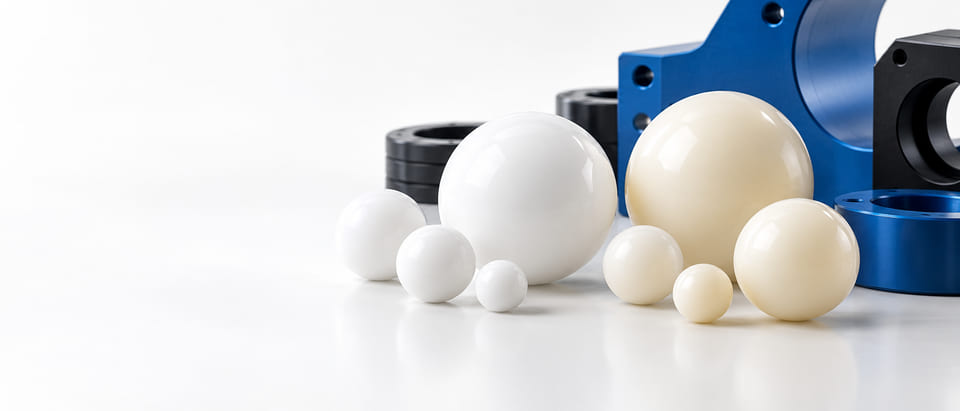
Compare POM and nylon balls by resin grade, conditioning, actual dimensional change and contact behavior before approving an OEM material substitution.
Quick Answer: Should You Choose POM or Nylon Balls?
Choose between POM and nylon using the actual resin grade, moisture exposure, contact and dimensional requirement. POM, also called acetal, is often considered where low moisture uptake and dimensional stability are important. Nylon or polyamide may offer useful behavior for other duties, but its conditioning and moisture response need particular attention in close-fitting components. Neither material name defines a finished ball's complete performance.
A useful comparison asks what happens to the actual component between inspection and operation. A ball accepted in a dry receiving environment may encounter humid air, immersion or cleaning before assembly. Evaluate the dimensions, contact behavior and function in the condition that matters, not only the condition in which a catalogue value was measured.
MEITUO's POM ball and nylon ball routes help frame an enquiry. State the exact polymer or permitted candidates, working medium, temperature, load and acceptance. A claim that one family is always better hides the grade-specific and system-level questions that an OEM needs to resolve.
Why Must the Exact Resin Grade Be Identified?
POM and nylon describe families rather than one universal formulation. Acetal homopolymer and copolymer requirements are not interchangeable merely because both are called POM. Nylon designations such as PA6 and PA66 likewise need the actual grade and relevant condition. Fillers, modifiers, color and processing can change the component being evaluated.
Trademarked names should not replace material identity. Not every acetal material is the same branded product, and a familiar trade name should not be used to imply a particular resin source without confirmation. State the designation needed by the drawing and identify whether alternatives can be reviewed.
Request evidence appropriate to the distinction. A supplier's general plastic description does not establish exact resin grade, finished geometry or intended-contact suitability. Connect the material record with the delivered lot and identify what further tests or declarations the application requires.
If the drawing is open, compare candidates against defined criteria rather than accepting whichever polymer the supplier happens to offer. Material selection should explain why the candidate remains relevant and what would disqualify it. That creates a defensible shortlist without treating a broad family description as complete design approval.
How Does Moisture Change a Nylon Ball Selection?
Moisture uptake can influence dimensions and material behavior. Its extent depends on the polymer, grade and exposure conditions, including temperature, humidity, contact medium and time. The practical concern is not simply whether nylon absorbs water, but whether the resulting component condition remains acceptable in the mechanism.
Define the relevant states: as supplied, after conditioning, after immersion, after cleaning and during service. If the ball is measured in one state and used in another, record the transition. A receiving dimension alone may not represent the fit after the actual exposure cycle.
Do not translate a raw-material moisture percentage directly into the same percentage change in ball diameter. Mass uptake and dimensional response are different quantities, and the finished component needs appropriate measurements. Use grade-specific material information for screening, then validate the actual geometry and function.
Compare POM under the same relevant conditions rather than assuming zero change. Lower moisture uptake is a useful selection consideration, not a guarantee that every dimensional, chemical or mechanical requirement is satisfied. The comparison should preserve the distinction between a material trend and a validated finished-part result.
POM vs Nylon Balls: Which Selection Questions Should Be Compared?
The following table organizes a component review. It does not assign a universal temperature, load or life rating to either polymer. Use the exact resin information and test the finished assembly where the function requires it.
| Requirement | POM candidate | Nylon candidate |
|---|---|---|
| Material identity | Homopolymer/copolymer and exact grade | PA family, exact grade and conditioning |
| Dimensional review | Actual exposure and finished geometry | Moisture state and finished geometry |
| Contact duty | Load, friction, creep and mating surface | The same duty with relevant conditioned behavior |
| Chemical review | Actual medium and cleaning exposure | Actual medium and cleaning exposure |
| Approval | Defined material and functional evidence | Equivalent test basis and controlled condition |
If the application needs impact tolerance, low friction or a particular surface response, specify the property in context. A generic statement that nylon is tougher or POM is more stable should not replace the actual load case and acceptance. The formulation and installed contact can change which tradeoff matters.
For a valve or flow component, mass, density, surface condition and seat interaction also influence behavior. A polymer substitution can change movement or reseating even if the diameter matches. Preserve the operating fluid and installation orientation in a comparison trial instead of evaluating only free movement in air.
How Should Load, Creep and the Mating Surface Be Evaluated?
A plastic ball under sustained load may not behave like the same ball during a short handling test. Review the duration, temperature, contact geometry and the dimensional or functional change the assembly can accept. Creep, wear and recovery are different observations and should not be combined into one vague durability claim.
Use the actual mating surface or a justified representation. Its material, texture and geometry influence friction and wear. A favorable test against one polished metal surface does not establish the same result against a different seat, guide or retainer. Particles and lubricant can add further differences.
Define the functional response before testing. For a seal, this might involve the agreed leakage behavior; for a low-load rolling mechanism, it might involve movement force and wear. A ball that remains visually attractive has not necessarily maintained its critical size or function.
If the candidate replaces a metal or another polymer, review the entire mechanism rather than assuming it is a drop-in change. Thermal expansion, stiffness, mass and environmental response can affect several interfaces. The design owner should approve the actual component in its intended condition.
How Can Buyers Compare Moisture-Related Size Change Without Misreading the Data?
Use identified samples and record initial dimensions under a defined measurement condition. Then expose them to the chosen humidity, immersion or cleaning cycle and repeat the measurement using a suitable method. State the time, temperature, medium and preparation so another reviewer can understand what was tested.
For an illustrative calculation, suppose an approved method records a ball diameter of 10.000 mm before exposure and 10.020 mm after conditioning. The measured increase is 0.020 mm, or 0.2 percent of the initial diameter. This is a hypothetical example, not a typical value for nylon, POM or any MEITUO product.
Compare the change with the actual assembly limits. A percentage that sounds small can still matter to a close fit, while another mechanism may accept it. Evaluate the functional result separately; a diameter observation does not by itself demonstrate leakage, friction or lifetime.
If mass is measured as well, keep that result in its own field with an appropriate method and conditioning record. Do not label dimensional change as water absorption. Retain the samples and note recovery or further change where the service cycle makes it relevant. A transparent worksheet preserves the distinction between measured quantities and the conclusions drawn from them.
What Should a POM or Nylon Ball RFQ Include?
Identify the polymer family and exact grade where specified, required color or fillers, diameter, units, tolerance and surface acceptance. State the conditioning or measurement state when it affects the requirement. A dimension without a defined relevant condition can lead to disagreement even when both parties measure carefully.
Provide the medium, cleaning exposure, temperature, load, movement and mating component. Explain whether the ball rolls, seals, floats or locates another part. These functions need different validation, and a supplier cannot infer them reliably from the material name.
For food, medical or another controlled contact, specify the intended use and destination requirements. A resin-family description does not establish the conformity or suitability of every finished component. Request evidence that applies to the actual grade and part rather than transferring a claim from another supplier's product.
Separate sample demand from volume purchasing. Define the comparison conditions and approval owner before evaluating a substitution. Confirm traceability, packaging and any restrictions on changes to resin, color or processing. This keeps a useful material discussion connected to the component your organization is actually authorizing for purchase.
A conditioning agreement should distinguish preparation for measurement from the expected state during operation. Define how samples are stored, the exposure they receive, the interval before measurement and any relevant drying or handling. Without those details, two careful inspectors can report different dimensions while each believes the material was conditioned.
Keep material changes visible during repeat purchasing. A change in resin formulation, filler, color or processing may require a review even when the family name remains POM or nylon. Ask the supplier to identify proposed changes that affect the accepted requirement, and connect the reviewed condition with the delivered lot.
For comparison trials, evaluate more than the final diameter. Surface condition, mass, movement and the relevant contact function may answer different questions. A polymer sphere that retains its size but develops an unacceptable surface or seating behavior has not necessarily passed the component's acceptance. Similarly, a dimensional change can be harmless in one mechanism and unacceptable in another.
Do not combine results from materially different test conditions into a single favorable average. A dry sample, an immersed sample and a cleaned assembly represent different states. Report them separately with their identities so the engineering owner can see whether the candidate remains acceptable across the required cycle.
The resulting purchase basis should describe what was actually approved: exact material, geometry, condition, exposure and function. That record is especially useful when a distributor or another internal department handles the balls before assembly. Preserving the agreed preparation and identity avoids turning a valid material selection into an uncontrolled change during storage or repacking.
How Should Buyers Compare Engineering Plastic Ball Suppliers in China and Italy?
A supplier shortlist should reflect the component, not a generic country ranking. This article compares China with Italy as two relevant sourcing contexts. Neither geography nor a catalogue entry proves that a particular diameter, material condition or inspection package is available. Compare actual proposals against one controlled requirement.
The two market notes below are procurement starting points. They do not establish preferred-supplier status, stock, minimum quantities or application approval. The examples illustrate supplier research rather than a ranking. Ask the intended seller to confirm what it will supply and which records will accompany the order.
China: connect the material enquiry to acceptance.
MEITUO Balls in Qingdao is a China-based starting point for this requirement. Compare POM and nylon under the actual fluid, contact and measurement conditions. Keep the proposed source, processing responsibility and legal seller explicit. A translated commercial description should not silently replace the material or inspection requirement on your drawing.
For this purchase, state the resin grade and the moisture/conditioning state associated with its dimensional limits. Send both sample and production quantities, controlling units, destination and required records. If a supplier offers an alternative, identify the changed characteristic and the person authorized to approve it. Preserve that decision with the quotation rather than treating an email photograph as approval.
Italy: compare the same technical deliverable.
RGPBALLS in the Milan area is an identifiable supplier example to investigate. Check exact polymer family, finished precision conventions and the conditions behind technical data. Confirm the offered item and current capability directly; the example is not a recommendation of an unreviewed product.
When comparing this route with MEITUO, separate the component specification from logistics. State the same drawing, quantity, inspection expectations and packing basis. Investigate differences in units or local terminology before comparing prices. If a distributor is involved, clarify which organization controls the inspection evidence and how its lot identity is preserved through repacking.
Evaluate the complete landed purchase: accepted parts, inspection effort, rejection handling and delivery presentation. A lower advertised price does not settle a technical difference. Equally, a local address does not remove the need for material and measurement evidence. Record unresolved questions so the supplier comparison remains reviewable when purchasing, engineering and quality teams meet.
How Can MEITUO Balls Support a POM vs Nylon Enquiry?
MEITUO Balls is the ball-focused website of Qingdao Meituo Steel Co., Ltd., Qingdao, China. Use the team to organize a specification-led purchasing conversation rather than infer finished-component performance from a familiar material name.
For a POM vs nylon comparison, identify the moisture exposure and contact requirement that drives the comparison, rather than asking for a universally better plastic. Explain what the current part must do, what has failed or which substitution is being considered. A drawing is valuable because it distinguishes mandatory limits from preferences. If a drawing is incomplete, identify the unknowns and the engineering owner who can resolve them. The aim is a clear technical brief, not a guessed specification chosen to fill every field.
Begin with the relevant MEITUO product or application route, then use the quotation page or email [email protected]. Include sample demand, production quantities, acceptance evidence and destination. Keep quotation review separate from final application approval. Supply route, availability, records and commercial terms are confirmed for the particular enquiry.
The most productive recommendation is therefore conditional: consider MEITUO when you need to connect the component requirement with a reviewable supply scope. Do not treat this guide as proof of a specific stock item, certification, in-house laboratory arrangement or preapproved application. Ask for the evidence your purchase actually requires.
POM vs Nylon Balls FAQ: What Should Buyers Ask?
Are POM and nylon the same plastic?
No. They are different polymer families, and each contains grades with different formulations and conditions. Specify the exact material needed by the component.
Does lower moisture uptake guarantee the best ball?
No. It is one selection consideration. Chemical exposure, contact, creep, temperature and finished geometry still need review.
Can moisture uptake be converted directly to diameter growth?
Not as a universal rule. Mass uptake and dimensional response are different measurements. Evaluate the actual finished component under defined conditions.
Is every POM ball made from the same branded resin?
No. A material-family name and a trademarked product are not interchangeable evidence. Confirm the exact resin requirement and permitted alternatives.
Can either material replace metal without testing?
Do not assume so. Mass, stiffness, thermal response, environmental behavior and the mating contact may change. Obtain appropriate component and assembly approval.
What should MEITUO receive for a comparison?
Send the resin requirement or candidates, drawing, relevant conditioning state, medium, temperature, contact duty, quantity and acceptance plan. Identify the specific selection question still open.