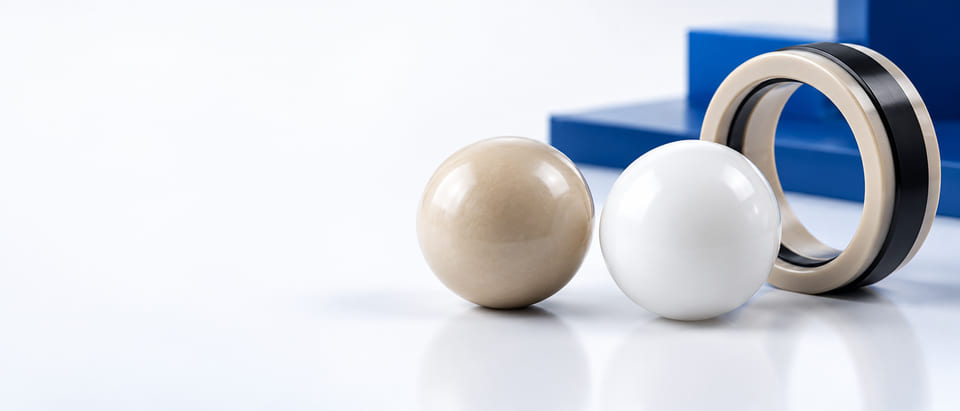
A high-performance resin name is not a business case. The PEEK-versus-POM decision becomes useful when an engineer can identify the service limitation, explain how the proposed material addresses it and measure the resulting benefit without moving the failure elsewhere.
Quick Answer: When Should PEEK Replace POM Balls?
Consider PEEK when an identified combination of temperature, mechanical load, chemical exposure or dimensional behavior exceeds what the proposed POM ball can demonstrate. Keep POM in the comparison when it already meets the duty at acceptable cost. PEEK is not an automatic upgrade for every lightly loaded guide, valve or low-load contact.
The comparison needs exact formulations, finished dimensions, mating material and the relevant operating history. POM can be supplied as different resin types; PEEK includes unfilled and filled grades with different contact behavior. Neither family name establishes the finished sphere’s tolerance, wear rate or approval for a regulated application.
Bring the actual limiting condition to MEITUO’s material-selection review. A useful proposal explains what POM cannot currently achieve, which PEEK evidence is needed and what additional testing costs. If the limiting mechanism remains unknown, a more expensive ball can leave the original problem unresolved.
What Is the Real Material Difference Between PEEK and POM Balls?
PEEK is a high-performance semi-crystalline thermoplastic, while POM is an engineering acetal polymer. Their chemical structures and available formulations create different thermal and mechanical envelopes. A ball buyer should translate that distinction into the actual contact requirement rather than ranking the families by reputation.
For POM, identify whether the proposal is a homopolymer or copolymer and whether additives are present. For PEEK, establish the exact resin and any reinforcement or tribological filler. A carbon-filled PEEK proposal is not the same comparison as unfilled PEEK against unfilled POM. Filler can alter stiffness, expansion, electrical behavior, debris and mating-surface wear.
Compare finished-ball properties only on an agreed basis. Resin tensile coupons, machined stock-shape data and a small curved contact represent different geometries and processing histories. A numerical advantage in a datasheet may guide the shortlist without predicting the allowable load of a sphere in an actual seat.
Separate material limitations from component defects. An oversize POM ball in a tight guide may bind because the drawing or receiving condition is wrong. Substituting PEEK without correcting the clearance can produce another binding contact. Conversely, a properly sized POM ball may fail during a hot loaded dwell even though the room-temperature drawing is satisfied. Those cases need different corrective actions and should not share the same material recommendation.
Which Temperature and Exposure Conditions Can Justify PEEK?
Temperature should be specified at the ball, not merely at the machine enclosure. Include cold start, normal operation, transient peaks, cleaning cycles and the time spent under load at each state. A short unladen exposure says little about a sphere compressed against a seat throughout a long hot shutdown.
Do not use a melting point, glass-transition temperature or heat-deflection value as a finished-ball operating rating. These properties come from different methods and describe different phenomena. The relevant question is whether the exact ball retains the required geometry and function under the combined load, time and environment of the application.
Chemical compatibility also needs a recipe and sequence. Process fluid, cleaning agent and lubricant can impose different demands. A material might remain visually intact yet change in dimension, friction or extractables. When the contact involves hot water or repeated sterilization, the entire cycle and required evidence should be stated explicitly rather than inferred from a general polymer label.
Build an exposure map with one row per operating stage. Enter ball temperature, duration, force state, fluid and required restart behavior. Mark which stages have evidence and which remain untested. This map can reveal that the real benefit of a PEEK proposal concerns a brief cleaning stage, not normal production. It can also show that a less expensive POM proposal remains acceptable if the process conditions are controlled differently.
PEEK vs POM: How Should the Contact-System Comparison Be Structured?
A mechanism-level comparison helps avoid paying for a property that does not control the application. If the concern is wear, evaluate the ball against the actual mating material and finish. If the concern is geometry after dwell, measure time-dependent deformation and recovery. If the concern is motion, record friction and movement in the intended fluid.
Keep the initial contact geometry equivalent where practical, but document legitimate differences in the proposed finished parts. An extra finishing step, different size distribution or changed seat can influence results independently of resin. Those details belong in the comparison instead of being hidden behind the material name.
A filled PEEK ball that wears slowly can still be unacceptable if it damages a soft mating surface or releases prohibited filler debris. Conversely, an unfilled POM ball may be adequate in a low-load, moderate-temperature guide when the required life is demonstrated. The best choice is the acceptable contact pair, not the hardest sphere.
Review electrical and product-contact requirements independently. Do not presume all plastic formulations are equivalent insulators or that an industrial resin description establishes food, medical or drinking-water compliance. Any required declaration must cover the exact formulation, intended use and relevant finished-component scope.
| Question | POM candidate | PEEK candidate | Decision evidence |
|---|---|---|---|
| Service envelope | Check exact acetal type and environment | Check exact PEEK grade and load-dependent behavior | Representative loaded exposure |
| Sliding contact | Test against the actual counterface | Include any filler-related counterface effect | Friction, wear and mating-part inspection |
| Geometry | Measure conditioned and operating-state fit | Measure the same states and recovery | Clearance budget and dimensional records |
| Commercial value | Use accepted unit and operating costs | Include qualification and change costs | Cost per accepted service interval |
How Can Buyers Calculate Whether the PEEK Premium Pays Back?
Use an explicit economic model with assumptions that purchasing and engineering can challenge. The model should distinguish a demonstrated result from an estimate. Avoid presenting a projected maintenance saving as a verified property of the resin.
Consider a hypothetical assembly using one ball. Assume a POM ball costs $2, a PEEK candidate costs $10, and each planned replacement event costs $90 in labor and controlled interruption. Over a defined evaluation period, suppose the approved POM schedule requires four replacements, while a proposed PEEK schedule would require one. Ball-plus-replacement costs would be 4×($2+$90) = $368 and 1×($10+$90) = $100. The apparent difference is $268 per assembly. These are invented planning inputs, not MEITUO prices or demonstrated replacement lives.
Now include qualification. If the PEEK program costs $8,000 and only 20 assemblies use the change, the allocated qualification cost is $400 each. That allocation exceeds the hypothetical $268 benefit during the chosen period. At 100 assemblies, the allocation becomes $80 each, but the replacement assumption still needs validation.
Use sensitivity cases rather than a single optimistic line. What happens if PEEK lasts for only two replacement intervals, if downtime is lower, or if the mating seat needs replacing too? Keep quality loss, contamination and safety requirements as separate constraints; a low calculated cost does not authorize an unacceptable failure mode. A material premium is justified by accepted evidence and the relevant operating economics together.
What Test Plan Can Demonstrate a Useful PEEK Improvement?
Begin with the approved POM configuration as a control if one exists. Identify both materials and record initial sphere and mating-part condition. Define the test’s purpose: a higher temperature envelope, reduced deformation, less wear or fewer interruptions. A vague objective such as prove better encourages selective interpretation.
Run the comparison through the limiting sequence, including startup and shutdown where relevant. Measure the functional endpoint at planned intervals rather than relying only on a final photograph. For a valve, leakage and actuation may matter; for a guide, movement force and positional repeatability may matter. Choose endpoints tied to the intended mechanism.
At teardown, examine both members of the pair and retain representative debris when contamination is a concern. If the PEEK ball appears unchanged but the metal or polymer seat has deteriorated, the contact system has not necessarily improved. Document whether the test was stopped for an endpoint failure or merely reached its planned duration.
A useful diagnostic sequence can distinguish thermal interference from frictional damage. First confirm movement at the reference temperature with identified specimens. Next bring the complete contact to the intended operating state and measure movement before prolonged cycling. Finally run the loaded dwell or motion sequence and examine recovery after cooling. A restriction that appears immediately on heating suggests a different question from one that develops only after hours of sliding. The sequence does not identify the mechanism by itself, but preserves when the change began. If lubrication, guide alignment or seat force is adjusted during this work, record a new configuration rather than treating the adjustment as part of the original resin comparison. This detail prevents an improved setup from being credited entirely to the PEEK material.
Avoid extrapolating a short accelerated trial into an exact field life without a supported model. Higher load or temperature can change the mechanism rather than simply speed it up. A staged evaluation can screen candidates, then assess a pilot assembly under representative duty. Preserve the test conditions with the conclusion so later users do not turn a bounded improvement into a universal substitution rule.
Which Buying Rules Prevent an Unnecessary Material Upgrade?
Make the purchasing requirement follow the engineering conclusion. If POM has been validated within a defined envelope, retain that envelope and its controls. If PEEK is selected for a specific hot-cleaning stage, say so. A purchasing team should be able to understand what would trigger a new review.
An enquiry should state exact resin or proposed alternatives, diameter, geometry, surface requirements, quantities and sample objective. Identify the documents needed to map material and finished lots. Confirm any processing or formulation restrictions before comparing prices. The phrase equivalent high-performance polymer is too broad for a controlled substitution.
Agree the distinction between development samples and repeat supply. A successful hand-finished prototype does not establish a future production process without an agreed connection. Ask how the offered production parts will relate to the evaluated samples and which changes require notification. Inspection should address the characteristics that control the approved contact.
When the economics do not support PEEK, document that outcome without calling the material unsuitable in general. It may be technically capable but unnecessary for this application. When PEEK is justified, retain the qualification cost and benefit assumptions for later review. Changes in volume, maintenance practice or duty can alter the business case even while the material specification stays the same.
Which Regional Routes Support a PEEK-versus-POM Review?
A finished-ball quotation and a resin technical discussion serve different purposes. Buyers can use both, provided the evidence remains connected to the actual finished sphere. The examples below identify regional starting points and the specific question each route can help frame.
China: Qingdao, Shandong
MEITUO Balls can receive a China-based component enquiry comparing PEEK and POM against the actual drawing and service limit. State whether the project is resolving a field failure or developing a new envelope. Ask for the proposed grade, supply scope and sample basis to be confirmed. Keep the Chinese sample identification aligned with the OEM’s test and receiving records.
United Kingdom: Thornton Cleveleys, Lancashire
Victrex is headquartered in Thornton Cleveleys and publishes PEEK material technical guidance. This is a resin and application-development reference route, not an assumption that loose finished balls are offered. A UK buyer can use exact-grade information to define the PEEK candidate, then require the finished-ball source to connect its material and processing records to that proposal.
Italy: Cinisello Balsamo, Milan
RGPBALLS publishes PEEK and POM ball categories from its Cinisello Balsamo headquarters. The catalogue supports a finished-component sourcing discussion in Italy. Ask which specific POM type or PEEK formulation is proposed and what can be confirmed for the required size. Do not compare an unspecified filled PEEK quotation with an unfilled POM control as though resin family were the only changed variable.
For international sourcing, use the same exposure map and economic assumptions across offers. Lower freight, a recognized brand or a nearby technical office can affect procurement practicality, but none establishes that the offered sphere has passed the OEM’s contact-system test.
How Can MEITUO Help Turn the Material Comparison into a Purchase?
MEITUO Balls is the ball-focused website of Qingdao Meituo Steel Co., Ltd., in Qingdao, China. Its company profile describes a specialty-steel background. Engineering-polymer proposals require confirmation of the actual material, component source and agreed records for the enquiry.
For this decision, send the present POM requirement, the limiting service stage and the target improvement before requesting a PEEK quotation. Include any accepted baseline results and explain which values in the cost model are estimates. That brief gives the component discussion a specific purpose and helps identify whether the proposed samples can answer it.
Use the sampling and validation page to organize candidate identity and the evaluation scope. The quotation route or [email protected] can carry the drawing, quantity and technical questions. Keep the final material selection with the contact-system evidence and approved operating envelope, so repeat purchasing preserves the reason for the change.
PEEK vs POM Balls FAQ: What Should Buyers Ask?
Is PEEK always better than POM for precision balls?
No. PEEK can address more demanding combinations of conditions, but the actual application may already be satisfied by POM. Compare exact formulations, finished geometry, contact behavior and accepted total cost before paying a premium.
Can a PEEK temperature rating be used as the ball rating?
Not directly. Datasheet thermal properties use specified methods and specimens. The finished ball’s suitability depends on load, time, temperature, environment, geometry and the required function in the assembly.
Does filled PEEK always reduce wear?
No universal result should be assumed. Filler identity and content influence the ball and its mating surface. Test the actual pair for friction, ball wear, counterface wear and any unacceptable debris.
Which costs belong in the PEEK-versus-POM calculation?
Include accepted component cost, inspection, qualification, replacement labor, interruption and relevant mating-part costs. Keep projected life and downtime assumptions visible, and test whether the conclusion changes when those assumptions vary.
Can I replace POM with PEEK without changing the drawing?
A material-only change can still affect dimensions under service conditions, contact response and required documentation. Review the drawing and operating envelope, identify the proposed formulation and obtain the relevant technical approval.
What is the best starting point for a MEITUO enquiry?
Describe the condition that POM cannot currently meet, provide the current drawing and exact duty, and define what a successful PEEK trial must demonstrate. Ask for candidate material and sample traceability to be confirmed for the proposed order.