Changing from unfilled to filled PTFE changes the formulation, not just the price or color. A useful specification connects the selected filler system with the deformation, wear and cleanliness requirements of the actual ball contact.
Quick Answer: When Should a PTFE Ball Be Filled?
A filled PTFE ball may be worth evaluating when unfilled PTFE cannot meet a defined deformation, wear or thermal requirement. Specify the exact compound and assess its consequences for the mating surface, chemical exposure, electrical behavior and permitted debris. Filled PTFE is a broad category; glass, carbon, graphite, bronze and other additions do not create equivalent materials.
Unfilled PTFE may remain the better candidate when the application prioritizes a particular purity requirement or when its demonstrated contact behavior already meets the duty. Conversely, unfilled material should not be selected solely because it sounds chemically simple. The complete formulation, finished component and intended exposure still need confirmation.
Use MEITUO’s material-selection discussion to connect the proposed compound with a specific failure mechanism. Ask what the filler is intended to improve and which new risks the change introduces. A substitution should be accepted by evidence for the complete contact, not by the phrase reinforced PTFE.
Which PTFE Formulation Details Must Be Identified?
The formulation record should identify the base resin or compound designation, filler identity and the content basis used by the supplier. If percentage content is critical, state whether it is mass or volume fraction. The same percentage stated on different bases does not describe the same material composition.
Multiple fillers or proprietary packages need a clear agreed identification route. A buyer may not receive a supplier’s entire formulation recipe, but an uncontrolled commercial description is inadequate when a specific additive could affect corrosion, conductivity or contamination. Define the information needed for the intended application and how a change will be communicated.
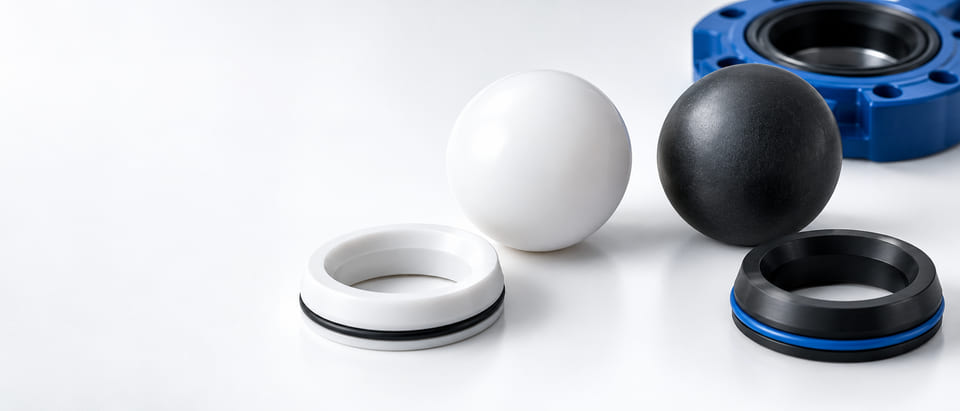
Do not identify a compound by color. A dark sphere can contain different carbonaceous or other additions; a pale sphere may contain glass or other ingredients that are not obvious visually. Packaging and documentation should preserve the accepted compound identity through finishing, inspection and delivery.
Where filler exposure at the finished surface is relevant, define how that feature will be assessed and how the result connects with the contact requirement.
The finished-ball record also matters. A correct compound can be processed or finished differently, affecting geometry and surface condition. If a sample is made by a special development route, establish how it relates to repeat production. Preserve enough information to distinguish a formulation change from a finishing change when later results differ. The requirement should be meaningful and confirmable, rather than a collection of material terms that no party can trace to the supplied lot.
What Can Fillers Change Besides PTFE Wear Resistance?
Fillers can alter stiffness, deformation under sustained load, thermal expansion, heat conduction and sliding behavior. The direction and magnitude depend on the filler, amount, dispersion, processing and test conditions. A compound intended to reduce one form of wear is not automatically superior for sealing, impact or chemical cleanliness.
The counterface needs particular attention. A harder or abrasive constituent can change wear of a softer mating seat. A reduction in ball mass loss may accompany increased seat damage, debris or leakage. Evaluate the pair and inspect the region that controls function rather than declaring success from the ball alone.
Electrical behavior is another independent question. Some filled formulations can differ substantially from unfilled PTFE in conductivity or resistivity. Do not infer insulating performance from the word fluoropolymer, and do not infer a required dissipative value merely from a carbon-related filler description. The exact grade and relevant electrical test conditions must support the requirement.
Specific supplier examples show why the filler name matters. Daikin’s guidance for its 15GL/25GL glass-fiber compounds flags soft-metal counterpart limitations. Its 25CAR hard-carbon entry identifies restrictions with strongly oxidizing media, including certain acids, bleaches and halogens. The soft-carbon entry also notes that highly filled material can be electrically conductive. These are cautions tied to that supplier’s stated compound families, not a performance guarantee for every finished ball containing glass or carbon. They create concrete review questions: will this exact compound abrade the selected seat, encounter the restricted chemistry or violate the electrical requirement?
For chemicals, assess both the polymer and the filler system. A medium compatible with the base polymer may interact differently with an exposed filler or compound constituent. Cleaning, oxidation, moisture and temperature can alter the concern. The correct response is a formulation-specific review and representative exposure, not a universal claim that all filled PTFE retains every property associated with unfilled PTFE.
Filled vs Unfilled PTFE: How Should the Trade-Off Be Compared?
Start with the actual problem. A ball that deforms during a long loaded dwell needs a different comparison from one that produces excessive sliding debris. Identify the relevant endpoint and set limits before comparing candidates. Do not use a single hardness reading as a proxy for all contact behavior.
Retain an identified unfilled control if that is the current material. Compare it against each named compound with the same drawing and contact arrangement, or document any necessary geometry differences. If the test changes both the filler and seat finish, the resulting improvement belongs to the revised configuration rather than to filler alone.
A compound’s datasheet can help define a screening hypothesis, but relative wear rankings may come from a different specimen geometry, pressure, speed or counterface. Confirm whether the published result is transferable enough to justify a trial. The final acceptance evidence should answer the actual contact question.
Avoid a blanket approval for all filled PTFE after one compound passes. The accepted reference should identify the formulation and its relevant state. If a second supplier proposes a different compound under the same general description, review the changed properties and evidence rather than treating the family name as an equivalence certificate.
| Decision factor | Unfilled PTFE candidate | Specified filled compound | Needed evidence |
|---|---|---|---|
| Sustained seating | Evaluate deformation and recovery | Evaluate compound-specific behavior | Loaded dwell at service conditions |
| Sliding wear | Measure ball and counterpart | Check any abrasive or transfer effect | Pair-level wear and function |
| Chemical service | Review exact unfilled proposal | Review filler as well as polymer | Representative mixture exposure |
| Cleanliness or electrical duty | Confirm actual material scope | Assess additional constituents | Relevant analytical or electrical test |
How Can Buyers Calculate a Formulation or Contamination Budget?
Use an explicit calculation to avoid confusing compound mass, filler content and measured release. Suppose an illustrative 2.00 g ball contains 15% filler by mass. Its initial filler inventory is 2.00×0.15 = 0.300 g. This is an inventory calculation using hypothetical inputs; it does not show that 0.300 g will be released or that a given compound is acceptable.
Now suppose a controlled wear trial reports 4 mg total ball mass loss. Multiplying 4 mg by 15% would give 0.6 mg only under an assumed proportional loss model. That model may be wrong: filler and polymer can leave the contact at different rates or remain on the counterface. Where the released constituent matters, collect and analyze the relevant product, fluid or debris instead of treating the proportional estimate as a measurement.
For a hypothetical 20 kg product batch, 0.6 mg divided by 20 kg is 0.03 mg/kg. This number illustrates unit handling, not a contamination limit or exposure assessment. The permitted level must come from the actual product requirement and an appropriate analytical plan. Loss to filters or fixtures also prevents a simple ball-mass difference from establishing product concentration.
A simple receiving discrepancy can expose this distinction. Suppose a purchase reference identifies a specific glass-filled compound, while the sample label says only PTFE and the enclosed document describes a different filler family. A good diameter result cannot resolve which formulation is in the bag. Separate the samples, preserve the labels and ask the source to establish the material chain. Do not relabel them based on surface color or the compound that was expected.
If the source proposes a new compound because the original is unavailable, treat that as a technical proposal before the next test. Record what is intended to stay constant and what is changing. A limited trial can then answer a defined question without implying that the new formulation has inherited all prior chemical, contamination and contact approvals.
Keep the inventory, wear measurement and product analysis in separate fields. A purchasing team can then see which value is known and which is modeled. If filler content is stated by volume, obtain the necessary constituent densities and calculation basis before converting it; do not silently treat volume percent as mass percent.
Which Test Sequence Should a Filled PTFE Ball Pass?
Use a sequence that matches the proposed duty. A practical program can begin with identity and dimensional checks, proceed to chemical or thermal conditioning, then evaluate loaded contact and motion. Retain unconditioned controls to distinguish the effects of exposure from the original surface or processing state.
For a sealing contact, define seating force or pressure, dwell, temperature and leakage endpoint. Record dimensions at the agreed time after unloading. For sliding, define movement, speed, counterface and lubrication, and inspect both parts. A compound that reduces creep in one arrangement may not give acceptable reseating or friction in another.
If product contamination is important, plan collection before testing. Define the fluid volume, blank levels, sampling locations and relevant analytical scope. A visually clean fluid can still contain constituents of concern, while visible particles may come from the fixture rather than the ball. Proper controls are necessary to interpret either observation.
Record stop conditions and preserve failed specimens. Repeatedly cycling a leaking contact can spread damage and make the first failure mechanism harder to identify. At teardown, separate contact-induced findings from cleaning or handling marks. A successful finite test supports the specified configuration and conditions; it does not establish unlimited life, all-media compatibility or acceptance of every formulation sold under the same filler category.
What Should the Order and Change-Control Documents Preserve?
The order should state the accepted compound designation or agreed formulation reference, finished drawing, dimensions, surface criteria and inspection state. If a filler is prohibited or mandatory, say so directly. Do not rely on an informal statement such as equivalent PTFE when the functional review depends on a particular compound.
Define material-to-finished-lot mapping at a practical level. Identify which records will be supplied and what each record proves. A resin document can support the material chain without proving the ball’s geometry or the valve’s leakage. A finished inspection report can support dimensions without establishing every constituent of an unidentified compound.
Potential changes include base resin, filler type or source, content, processing route, stock source and finishing. Not every administrative revision requires a new life test, but the owner of the application should decide which changes can affect the approved mechanism. State the notification and approval scope before repeat supply begins.
For receiving, compare the label, formulation reference and inspection record with the purchase requirement. If the material description has drifted from the accepted compound to generic filled PTFE, resolve that identity issue before using a favorable dimensional report to release the shipment. An identifiable trial deviation can be evaluated without silently becoming the permanent repeat-order specification.
Which Sourcing Routes Can Clarify Filled PTFE Ball Proposals?
A compound manufacturer and a finished-ball supplier contribute different evidence. The compound source can help interpret an exact formulation; the ball source must connect that material to the offered geometry and delivery. An effective international review keeps those responsibilities visible.
China: Qingdao, Shandong
MEITUO Balls can receive a China-based enquiry for an unfilled-versus-filled PTFE comparison. Include the current failure mechanism, restricted constituents, seat or counterface and required sample evidence. Confirm the proposed compound and supply scope for the actual size. A clearly identified development candidate is more useful than a broadly described stronger PTFE ball.
Italy: Cinisello Balsamo, Milan
RGPBALLS publishes a PTFE ball category from its Cinisello Balsamo headquarters. This is a finished-ball discussion route; buyers should confirm whether the requested filled formulation is offered rather than infer it from the general PTFE page. Ask how the quoted material will be identified and what surface and dimensional requirements can be confirmed.
Germany: Nufringen, Baden-Württemberg
Ensinger, headquartered in Nufringen, publishes information on engineering-plastic compounds, stock shapes and parts. It is a materials and processing reference route for a German technical team. Treat any compound guidance as exact-material information and establish separately whether a finished ball source can supply and trace that proposal. Do not assume the organization offers every loose-ball formulation.
Ask each route to identify the exact scope it is offering. Technical access to a filler catalogue does not establish that a ball size is available, while a finished-ball quotation does not automatically establish all compound-specific application data. Align both with the same accepted formulation reference.
How Can MEITUO Help Specify a PTFE Compound Ball?
MEITUO Balls is the ball-focused website of Qingdao Meituo Steel Co., Ltd., in Qingdao, China. Its published profile describes a specialty-steel background. A specialist polymer request needs the proposed formulation, component source and evidence scope confirmed for that enquiry.
Send the unfilled baseline and explain the intended benefit of filling: less deformation, changed sliding behavior or another measured target. Add the chemistry, mating material and unacceptable constituents. This lets the discussion focus on a particular formulation decision rather than an undefined reinforced material.
The sample-validation route can organize candidate codes and the test sequence. Use the quotation page or [email protected] to provide drawings and quantities. Keep the accepted compound reference with the order, and keep the complete contact approval with the application owner. Neither record should be expected to replace the other.
Filled vs Unfilled PTFE Balls FAQ: What Should Buyers Ask?
Is filled PTFE always more wear-resistant than unfilled PTFE?
No universal ranking applies. Wear depends on the specific compound, counterface, load, speed, environment and method. A ball can lose less material while causing more damage to the mating surface.
Does carbon-filled PTFE remain an electrical insulator?
Do not assume that. Carbon-related formulations can have different electrical behavior. Specify the required property and method, then obtain evidence for the exact compound under the relevant conditions.
Can filler content identify the complete material?
Not by itself. Filler identity, content basis, base material, other constituents and processing matter. A percentage without a defined formulation reference can leave important differences unresolved.
Can I calculate product contamination from ball mass loss?
A mass difference does not establish where all material went or its composition. A proportional filler-loss estimate is only a model. Use an appropriate collection and analytical plan when actual product contamination matters.
Should a filled PTFE substitution keep the same surface criteria?
Review the criteria rather than copying them automatically. Filler and finishing can change the surface and contact behavior. Agree the relevant sealing or sliding region and verify the complete function.
What changes require renewed review after approval?
Changes that can affect the accepted mechanism need review under the agreed control plan. Examples include compound identity, filler system, processing or finishing route and the application’s fluid, temperature or load.