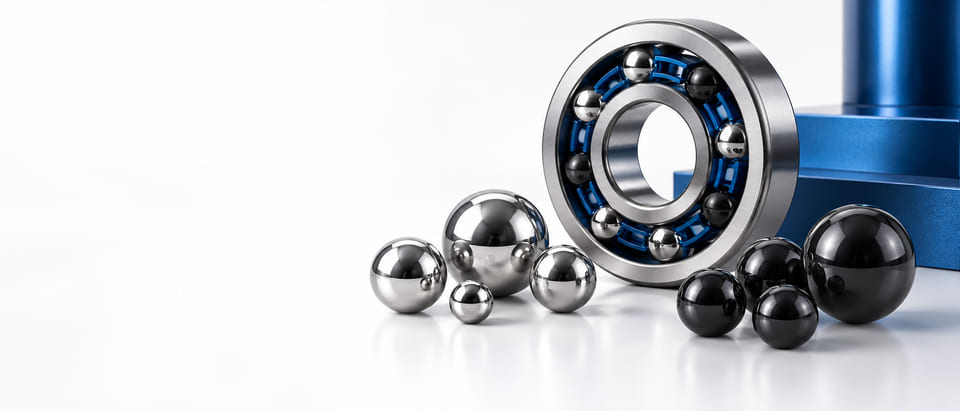
A promising rolling-element material is not a complete bearing design. Ceramic-versus-steel decisions become useful when they identify the limiting mechanism and the exact assembly result that needs to improve.
Quick Answer: Should OEM Buyers Replace Steel Bearing Balls with Ceramic Balls?
Only after reviewing the complete bearing and operating duty. Identify the exact material, ring and cage construction, clearances, lubrication, fits and required performance. A hybrid bearing can be an engineered solution to a defined problem, but loose same-size ceramic balls are not a universal retrofit. Validate the specific assembly and retain a documented approval basis.
MEITUO Balls can use these questions to review a defined component enquiry. Begin with the relevant product or application guide, then identify the conditions that your drawing does not yet resolve.
What Is the Difference Between a Ceramic Ball and a Hybrid Bearing?
A loose ceramic ball is a component. A hybrid bearing is an engineered bearing construction combining different materials, commonly steel rings and bearing-grade silicon nitride rolling elements. Buying one does not establish that the other has been designed or qualified. The cage, seals, lubricant, clearances and raceway geometry remain part of the system.
The term ceramic bearing is also used loosely. It may describe a hybrid arrangement or a construction with additional ceramic parts. Ask the supplier to identify the actual configuration. A comparison between a steel bearing and an unspecified ceramic bearing is not a controlled technical comparison.
Define the reason for the change before discussing advantages. A designer may need different electrical behavior, a response to a particular operating speed, resistance to an exposure or another specific result. Each objective creates different acceptance questions. Combining every advertised benefit into one assumed upgrade makes the study less useful.
For a replacement project, preserve the complete existing specification and operating history. Determine which elements of the bearing can be changed and who has authority to approve them. An equipment owner may require a qualified complete bearing rather than a purchase of loose replacement spheres. Avoid bypassing that requirement simply because a new ball has the same nominal diameter.
| Purchase description | Actual scope | Approval question |
|---|---|---|
| Loose ceramic balls | Specified rolling elements | Do they meet the component requirement? |
| Hybrid bearing | Rings, rolling elements and other bearing parts | Does the complete design meet duty? |
| Installed assembly | Bearing, fits, shaft, housing and operation | Does the equipment meet acceptance? |
Ceramic vs Steel Bearing Balls: Which Benefits Need Evidence?
Bearing-grade silicon nitride differs from steel in properties relevant to rolling contact. Those differences can create advantages in a suitable design, but the outcome depends on the complete bearing and its service. A material property alone is not a speed rating, temperature limit or promised life for an arbitrary assembly.
Lower ball mass can matter in demanding rotational conditions, while electrical behavior may be relevant to a motor-bearing strategy. Neither topic should be evaluated in isolation from the installed system. The bearing's internal design, lubricant, load, fits and temperature can influence whether the expected benefit is realized.
Compare like-for-like proposals. If a supplier changes the cage, seals, lubricant and internal clearance together with the rolling-element material, a successful test does not isolate the contribution of ceramic balls. That may still be an acceptable complete-bearing solution, but describe it honestly as a design change rather than a material-only experiment.
Steel remains a suitable choice in many applications. If the current bearing already meets its requirements and no limiting mechanism has been identified, a more expensive material may add little value. The decision should explain which problem the proposed ceramic construction addresses and which measured outcome will demonstrate the improvement.
| Objective | Evidence to plan | Unsupported shortcut |
|---|---|---|
| Electrical behavior | Installed electrical and bearing evaluation | Ceramic label proves complete motor protection |
| Running behavior | Load, speed, temperature and lubrication test | Material data alone set bearing limits |
| Longer service | A suitable qualification and field basis | A short quiet run proves life extension |
How Do Raceways, Preload and Lubrication Affect the Comparison?
A rolling element contacts raceways whose geometry and surface condition help define the contact. Changing the ball material can alter that relationship. The consequences depend on the particular bearing construction, so the raceway cannot be treated as a passive container for any same-size sphere.
Preload and clearance require review as part of the design. The installed fits and temperature differences can change the internal condition compared with an unmounted bearing. A component that turns freely on the bench may behave differently after assembly. Record mounting and operating conditions so a test result can be interpreted rather than reduced to a favorable initial impression.
Lubrication remains important. A claim that ceramic balls automatically remove the need for lubricant is not a basis for approving a rolling bearing. The steel rings, contact conditions, cage and operating environment still need an appropriate strategy. Follow the complete-bearing and equipment requirements when evaluating a proposal.
Check contamination and handling as well. A material substitution will not repair a damaged raceway or remove particles introduced during assembly. When noise, temperature or torque changes, examine these conditions before assigning the cause to the ball family. Keep the reference bearing and the candidate under comparable procedures so improvements or failures are not created by unrelated installation differences.
The comparison record should identify ring and ball materials, internal configuration, cage, seals, lubricant, shaft and housing fit, mounting procedure, load, temperature and operating sequence. Missing fields should be resolved with the design owner before the result is used to approve recurring supply.
Can Ceramic Balls Solve Electrical Bearing Damage on Their Own?
Electrical bearing behavior belongs to the complete machine. A hybrid bearing may form part of a protection strategy, but it does not automatically establish that every electrical path or damaging condition has been addressed. Identify the relevant equipment, operating electrical conditions and the role assigned to the bearing in the design.
Keep a material's insulating behavior separate from a system claim. The exact material grade, bearing arrangement and installed connections matter. Other paths through the machine can remain relevant. A purchasing description such as electrically safe ceramic balls is too vague to define an acceptance test or an equipment-level responsibility.
Plan evidence with the motor or machine owner. Determine which electrical and mechanical observations will be collected and what acceptance criteria apply. Preserve the operating conditions, instrumentation and arrangement when comparing alternatives. A bearing that produces a good result in one test does not qualify every motor, drive or installation.
Do not infer a past failure mechanism from appearance alone. Surface patterns and operating history may guide investigation, but an electrical diagnosis should be supported by suitable evidence. If the failure involved several mechanisms, replacing one component family may not resolve them all. Record the agreed hypothesis and the limits of the qualification rather than advertising a universal cure.
Procurement should identify whether the requirement is for loose rolling elements, a complete hybrid bearing or a larger approved machine arrangement. Request the corresponding evidence and responsible party. Do not ask a ball supplier to certify electrical performance of an installed system that it has not designed or evaluated.
How Should a Ceramic-versus-Steel Bearing Trial Be Structured?
Use an identified reference construction and a defined candidate. State the operating duty, test sequence, measurement methods and decision criteria before the trial. Include the relevant startup, steady-running and shutdown conditions rather than selecting only the easiest stable operating point.
For an illustrative comparison, suppose a project runs two bearing configurations under the same prescribed duty and records 50 operating hours for each initial screen. If one records a lower temperature, the observation applies to those identified constructions and conditions. It does not by itself prove longer fatigue life, a higher permitted speed or the isolated effect of the ball material. Further qualification must address the actual program requirement.
Measure the outcomes that motivated the change: for example, the defined thermal, movement, vibration or electrical result. Record instrument location, method and environmental conditions. A change in a sensor position can create an apparent improvement that has nothing to do with the bearing. Preserve raw results and exceptions so another reviewer can follow the conclusion.
Include inspection of the tested parts when relevant. A seemingly successful running result may still need examination of surfaces, lubricant or damage. Use retained samples or separate specimens if disassembly changes the test. Report adverse observations as well as favorable averages, and identify whether an interruption or adjustment affects comparability.
A staged plan can separate feasibility screening, design verification and production approval. Each stage needs an explicit outcome and an owner. An early result can justify continued investigation without being represented as complete qualification of every material, size or operating condition in the supplier catalogue.
For an explicitly hypothetical thermal worksheet, suppose corresponding measured points are 68°C and 62°C while ambient is 25°C in both tests. The observed temperature difference is 6°C; the calculated rises above ambient are 43°C and 37°C. This illustrates normalization of the readings, not guaranteed operating temperatures or proof of longer life. Record measurement location and instrument capability before treating such a difference as meaningful.
What Must Be Specified When Ordering Bearing Balls or Hybrid Bearings?
For loose balls, define the exact material grade, diameter, geometric and surface acceptance, required records and lot identity. If a bearing-specific material requirement applies, state it explicitly. General industrial ceramic spheres should not be treated as bearing-grade rolling elements merely because the product title uses the word precision.
For a complete bearing, preserve the full construction and manufacturer reference, together with required deviations or approved alternatives. Clarify whether seals, cage, lubricant, clearance and mounting requirements are included. A quotation that leaves these fields open may not describe the same item as the drawing being replaced.
Connect the accepted sample to repeat supply. Keep drawing revisions, material identity, source and inspection scope under change control. Where an existing approved bearing is changed, establish what evidence needs renewal and who signs off the alteration. A successful sample of one size or configuration should not automatically qualify a wider family.
Evaluate total cost against the stated objective. Include qualification effort, inventory, installation, inspection and consequences of failure alongside purchase price. A ceramic proposal may be valuable where it solves an identified problem, but a general premium-material claim is not a business case. The purchasing record should explain the reason for selection in terms that can be reviewed when the program or duty changes.
Send MEITUO the component scope, operating problem, relevant drawings, exact material or bearing reference, quantities and evidence needs. Clarify whether a loose-ball enquiry is appropriate or whether the equipment owner requires a complete bearing supplier. Source and acceptance responsibilities should be established before the commercial comparison is finalized.
Preserve the distinction between procurement and authorized maintenance. An equipment owner may prohibit disassembling a purchased bearing or replacing individual rolling elements. In that case, the correct purchasing route is an approved complete assembly, not a bag of apparently matching spheres. Establish those restrictions at the start of the enquiry.
For a new design in which loose balls are legitimately being specified, define how they will be handled and assembled without damaging critical surfaces. Identify whether the ball inspection occurs before assembly, whether the finished bearing receives a separate acceptance test and how a later assembly failure will be investigated. These responsibilities help avoid a dispute in which the ball supplier and bearing assembler were each assuming the other had approved the full product.
Which Suppliers and Local Purchasing Questions Matter for This Project?
The following supplier examples connect component sourcing with practical receiving and qualification questions. They are research starting points rather than a ranking. The proposed product, size, documentation and commercial scope should be confirmed directly for the actual purchase. Keep the same technical acceptance basis when comparing quotations from different locations.
China: Qingdao, Shandong
MEITUO Balls in Qingdao offers a China-based route for discussing rolling-element requirements. Make clear whether you are buying loose balls or evaluating a complete bearing change. A materials enquiry should include the required grade, geometry and inspection, while equipment-level performance needs the appropriate bearing and machine approval responsibilities. Confirm the actual supply scope before treating a component quotation as a complete-bearing proposal.
Sweden: Gothenburg
SKF publishes hybrid-bearing technical information and has a longstanding Swedish engineering presence in Gothenburg. This is an example of a complete-bearing technical sourcing route, not a claim that SKF offers loose replacement balls for every customer design. Use the complete construction and operating requirements when reviewing a hybrid proposal. Keep its scope distinct from a loose-ball quotation and verify the exact offered item and current documentation directly.
Compare offers using the same duty and acceptance requirements. An office address or familiar material name does not establish local stock, approved application performance or interchangeable supply. Keep the legal seller, source responsibilities and drawing revision identifiable. The choice between a domestic and international route should consider the cost of qualification, communication, inspection and replenishment as well as the first unit price.
How Can MEITUO Balls Support a Specification-Led Enquiry?
MEITUO Balls is the ball-focused website of Qingdao Meituo Steel Co., Ltd., in Qingdao, China. Its published company profile describes a specialty-steel background and a component-focused purchasing conversation. The source, processing, inspection and supply responsibilities are established for the particular component enquiry. Discuss any manufacturing-source or laboratory requirements with the proposed order so the documented scope answers your supplier-qualification questions.
For a ceramic-versus-steel bearing evaluation, send the specific decision you need to make, not simply a request for the best material. Include the current drawing, operating conditions, expected quantities and the evidence that will allow your team to approve the next step. Identify which requirements are fixed and which alternatives may be proposed. MEITUO can be included in that review without treating a catalogue description as finished-component qualification.
Explore the relevant component guide and sampling and validation route. Confirm technical acceptance and commercial terms in the quotation before committing to an order or changing an approved material.
Ceramic vs Steel Bearing Balls FAQ: What Should Buyers Ask?
Are ceramic balls a direct upgrade for any steel bearing?
No. The complete bearing design and duty must be reviewed. Ball material interacts with rings, cage, lubricant, clearance, fits and temperature. A matching nominal diameter does not establish that a material-only substitution is acceptable.
What is a hybrid bearing?
It combines different materials in the bearing construction, commonly steel rings with bearing-grade silicon nitride rolling elements. The full configuration must be identified because a ceramic ball alone is not a qualified hybrid bearing assembly.
Can a hybrid bearing eliminate every electrical damage risk?
No universal claim is justified. It may form part of an equipment-specific strategy, but the installed machine and other paths still need evaluation. Agree the relevant electrical and mechanical acceptance with the equipment owner.
Can a ceramic-ball bearing run without lubricant?
Do not assume so. Rings, cage and contact conditions still require an appropriate lubrication strategy. Follow the requirements of the complete bearing and equipment rather than applying a broad claim about ceramic material to an assembled product.
Does a cooler short test prove a longer bearing life?
No. It is an observation under the identified test conditions. Life, allowable operating limits and other requirements need their own suitable qualification basis. A short screening result can support further evaluation without proving every claimed benefit.
What should a ceramic bearing enquiry include?
Identify whether the item is a loose ball or a complete bearing, the exact material and geometry, construction, load, operating sequence, mounting conditions and required evidence. Explain the limiting problem so the proposal can be evaluated against a specific objective.