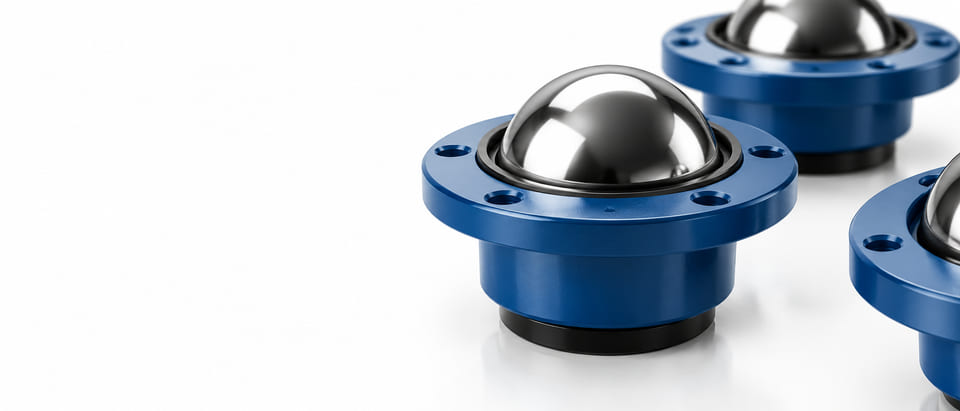
A ball-transfer table is a contact system, not simply a collection of high-grade steel spheres. For OEM buyers selecting load balls or evaluating a replacement, the important questions concern the complete unit, effective support, transported surface and operating conditions. A matching diameter cannot establish equivalent performance.
Quick Answer: How Should You Select a Ball Transfer Unit Ball?
Select the load ball as part of the complete ball-transfer unit and the handling installation. Identify whether you need the main load sphere, the smaller supporting balls or an assembled unit. Then review material, dimensions, contact with the product, load distribution, orientation, contamination and the manufacturer's unit-level operating limits.
A harder or more precise main ball cannot by itself establish a higher load rating. The supporting balls, seat, housing, seals, retention and mounting all participate in the result. Replacing only the visible sphere may therefore require evaluation beyond incoming diameter inspection.
Start with MEITUO's ball-transfer application guide and describe the actual component you are buying. For a drawing-controlled loose ball, provide the complete requirement and its role in the unit. For an assembled system, retain the relevant unit manufacturer's installation and load data and verify performance with the product being handled.
What Is the Difference Between the Main Load Ball and Supporting Balls?
A typical ball-transfer unit uses a larger main sphere supported by smaller balls within a containing structure. The main sphere contacts the transported item. The internal balls and supporting surfaces provide another set of contacts inside the unit. These parts cannot be treated as the same purchasing item merely because both are spherical.
Identify the component in a section drawing or marked assembly image. State main ball, internal supporting balls or complete unit explicitly. Include the part number and revision if one exists. A request for a ball-transfer bearing can otherwise be interpreted as several different supply scopes.
For the main ball, the product-contact surface and material are central questions. For internal balls, the supporting geometry, quantity, material and dimensional consistency need the unit designer's requirements. If either is changed, assess what that does to the other contact. A nominally harder replacement may alter contact stress or wear elsewhere without improving the whole unit.
Do not infer an assembly rating from a loose-ball catalogue. Unit manufacturers publish limits for defined constructions and conditions. Treat these as unit-specific information, not properties that can be transferred to every ball with a similar diameter. Where a replacement is proposed, clarify whether the original unit supplier or the equipment owner must approve it.
Preserve the assembly configuration during inspection. Mixing internal components from several units can make later diagnosis unreliable. Record where each suspect ball was installed and whether its seat, seal or housing showed related damage before replacing the visible part.
How Many Units Actually Support the Load at One Time?
Dividing the transported mass by every installed unit can underestimate the demand on the units that are actually carrying it. Product flatness, base stiffness, mounting height and the position of the center of mass influence which contacts participate. Transfers at edges and joints may change that participation during movement.
Illustrative load allocation, not a unit rating: assume a 48 kg item is supported equally by three effective contacts at one instant. Its allocated static mass is 16 kg per contact. If only two contacts participate, the equal-share figure becomes 24 kg per contact. Installing twelve units does not justify using 4 kg per unit unless the actual support condition establishes that distribution.
These figures omit impact, acceleration, uneven sharing and other design factors. They cannot be used to select a rated unit without the relevant manufacturer data and an installation-specific engineering review.
Map the entire transfer path, including entry, exit, stops and positions where the item rotates. The smallest or least rigid product may create a different worst case than the heaviest product. Define the actual contact geometry rather than using a convenient unit count from the equipment drawing.
If product loading changes over the operating cycle, record the relevant positions. Avoid assuming perfect equal sharing when the installation cannot maintain it. The equipment designer should establish the required margins and validate the selected construction under the actual conditions.
Product changes deserve their own review. Two items with the same mass can have different supporting footprints, centers of mass or base stiffness. A layout validated with one of them may not create the same effective contact for the other. Keep the smallest footprint and the difficult transition positions in the trial matrix. If the item includes a removable base or protective layer, state which configuration was tested. This prevents a purchasing specification from retaining a single load number after the contact conditions that made it meaningful have changed.
Steel vs Stainless vs Polymer Load Balls: Which Contact Does Each Change?
Material choice affects contact with the handled surface as well as the internal unit. Chrome or other hardened steel candidates may be considered for particular mechanical duties, stainless candidates for relevant corrosion exposure and polymer candidates for a different mass or surface-contact requirement. Those are screening directions, not unconditional recommendations.
| Candidate | Question to investigate | Do not assume |
|---|---|---|
| Hardened steel | Contact stress, wear, lubrication and surface protection | That high hardness makes every transported surface acceptable |
| Stainless steel | Exact alloy, condition and exposure | That the word stainless establishes corrosion immunity or the same rating |
| Polymer | Deformation, creep, wear, temperature and mating contact | That a softer or lighter ball is automatically non-marking |
Compare a material within a defined unit construction. If the housing, seals or internal components change at the same time, the trial is comparing complete unit variants rather than isolated main-ball materials. That can be a valid purchasing study, but its conclusion should reflect what was actually tested.
For loose replacement balls, state the exact material, condition, diameter, geometry and surface limits. Review the change with the unit or equipment owner before treating a similar-looking sphere as a direct substitute. Material identity and complete-unit performance remain separate acceptance questions.
Why Can Ball Transfer Units Mark a Soft Product Surface?
The visible main ball carries load through a local contact. Whether that contact marks the product depends on the transported material, finish, contact geometry, load and contamination, not only on ball smoothness. A polished hard sphere can still indent a surface that cannot tolerate the local contact.
Use production-representative product samples when evaluating marks. A thick test plate may behave differently from a thin panel, a coated part or a compliant package. Include the actual protective film if it is part of the process, and record whether it is clean and intact during the test.
Inspect for debris carried onto the sphere or trapped near the contact. A particle can introduce a scratch even when the original ball surface is acceptable. Determine whether the observed defect follows a contaminated unit, a damaged main ball, the handled product or the entry geometry.
A material change is only one possible corrective action. Different support spacing, entry control or contamination management may address the cause more directly. Test the proposed correction with the same product finish and the relevant loading history, then define how the accepted state will be maintained in routine operation.
Separate permanent indentation from a removable transfer mark. Cleaning a mark away may resolve an appearance question, but it does not prove that the process is harmless to a coating or sensitive surface. Agree the visual and functional criteria with the product owner before accepting the handling interface.
How Do Dust, Liquids and Temperature Affect the Ball-Transfer Decision?
Describe the environment around the whole unit. Dust and process particles can interfere with movement or contribute to wear. Liquids and cleaning agents may reach components beyond the visible main sphere. Temperature can change the relevant material behavior and the manufacturer's applicable load conditions.
Do not specify a stainless main ball as the entire corrosion solution if other exposed parts remain unsuitable. Review the housing, supporting balls, retaining components and any seals or drains. The relevant unit design may offer different protection features, but their suitability needs the operating and cleaning conditions.
For a washdown or chemical environment, provide the actual cleaning sequence: medium, concentration, temperature, exposure and drying conditions. A brief splash and repeated prolonged exposure are not the same duty. The equipment owner should also identify cleanliness requirements and what evidence applies to the finished handling assembly.
Where a polymer ball is considered, include sustained loading and temperature in the evaluation. A short demonstration of easy movement does not establish long-term dimensional stability. Review the actual resin or compound and the manufacturer's complete unit configuration before approving an alternative construction.
Define maintenance and inspection access at the same time as material selection. If the installation makes cleaning or replacement impractical, a good sample result may not remain representative in service. Use observed contamination and inspection records to refine the design rather than relying on a generic lifetime claim.
What Should a Ball-Transfer Installation Trial Measure?
Agree the trial around the actual handling tasks. Identify the product range, movement directions, starts, stops, entry transitions, orientation and operating conditions. Record the installed unit model and component variants so the results can be traced to a defined construction.
- Verify mounting heights and effective contact across representative product positions.
- Measure the force needed to initiate and continue the intended movement using a stated method.
- Check product marking and the condition of ball-contact surfaces.
- Observe transitions where support count or load position changes.
- Repeat after the relevant operating and contamination sequence.
Record individual observations rather than a single statement that the table runs smoothly. Starting force, sustained movement and movement in different directions may reveal different issues. An operator's useful observation should be tied to a repeatable condition before it becomes a procurement acceptance criterion.
For a hypothetical comparison, suppose two approved test conditions require starting forces of 30 N and 24 N. The reduction relative to 30 N is 6 N, or 20%. That calculation describes those observations only. It does not establish a material's universal friction coefficient or predict the force on another product, layout or contamination state.
Do not compare a clean new sample with a used contaminated unit and attribute the entire difference to ball material. Keep the comparison controlled, then test the selected arrangement under the realistic duty. Preserve failures and borderline results so the equipment owner can judge the limits of the evidence.
Also define how the installation will be maintained after acceptance. Record what operators should report when movement changes, which surfaces are inspected and what condition requires a unit to be removed from service. The appropriate intervals and limits belong to the equipment and its duty, not a universal recommendation. Link any replacement component to the accepted drawing and the unit it enters. That record is useful when a recurring symptom follows a replacement batch, a cleaning change or a mounting adjustment rather than the original design.
How Should China and Italian Ball-Transfer Supplier Options Be Compared?
China is included as a component-sourcing route, while Italy is relevant here because a specialist supplier publishes complete ball-transfer unit construction and material information. Compare the proposed scope before comparing price. Loose load balls and assembled handling units are different commercial and technical deliverables.
Qingdao enquiries: identify the component and its owner.
MEITUO Balls in Qingdao, Shandong can receive a drawing-led enquiry for the relevant spherical component. Identify whether it is a main load ball or an internal supporting ball, and provide the exact material and dimensional requirements. Do not assume that a loose-ball proposal includes the rating, installation design or approval of a complete transfer table. State which party owns those system-level decisions.
Italian specialist context: compare the complete unit construction.
RGPBALLS in Cinisello Balsamo publishes ball-transfer construction and use information, including main balls, internal balls and different unit families. It is a relevant Italian supplier example for researching assembled units. Review the actual model's data and operating conditions directly. A catalogue's unit-specific limits should not be copied onto a different loose ball or assumed to cover another installation.
Localize the RFQ with the receiving site, handling environment, drawing language and required documentation. Keep the technical scope constant across countries. A supplier's geography is a useful research signal, but it does not establish the load distribution or product-contact acceptance of your equipment.
How Can MEITUO Help Define a Ball-Transfer Component Enquiry?
MEITUO Balls is the ball-focused website of Qingdao Meituo Steel Co., Ltd., based in Qingdao, China. Its published specialty-steel background provides company context, while the exact product, source and inspection scope are established for an individual enquiry. This helps distinguish a useful component discussion from an unsupported claim about complete handling equipment.
Use the ball-transfer application page to describe the role, then send the drawing or a clearly identified sample reference. Include material and condition, diameter, form and surface limits, quantity and required records. If product marking or difficult movement prompted the enquiry, describe the actual product and operating condition as well.
Request the relevant review through MEITUO's quotation route. Keep component acceptance separate from the unit manufacturer's rating and the equipment owner's system validation. An agreed ball specification is a purchasing input, not a replacement for installation engineering.
Ball Transfer Unit Ball Selection FAQ: What Should Buyers Ask?
Is the largest visible sphere the only important ball in a transfer unit?
No. The main load ball interacts with smaller internal supporting balls and the containing structure. Identify which component is being purchased and evaluate the relevant interfaces rather than treating every sphere as the same item.
Can I divide product mass by every installed unit?
Only if the actual engineering analysis establishes that those units share the load as assumed. Flatness, stiffness, mounting heights, product position and transfer transitions can reduce the effective number of supports.
Does a harder replacement ball increase the unit load rating?
Not by itself. The rating belongs to a defined complete unit and operating conditions. Internal contacts, housing, retention, mounting and material changes may govern the result and require review.
Will a polymer main ball always prevent product marks?
No. Contact load, deformation, debris, product finish and the full unit design still matter. Test the actual transported surface and approved construction under representative conditions before accepting a non-marking claim.
Are the 16 kg and 24 kg figures recommended unit capacities?
No. They are hypothetical equal-share calculations for a 48 kg item with three or two effective contacts. They omit dynamic effects and other design factors and cannot select a rated unit.
What should MEITUO receive for a loose-ball enquiry?
Identify the main or supporting ball, drawing revision, material and condition, geometry, surface limits, quantity and evidence requirements. Describe the host unit and relevant failure or duty while preserving the equipment owner’s system-approval responsibilities.