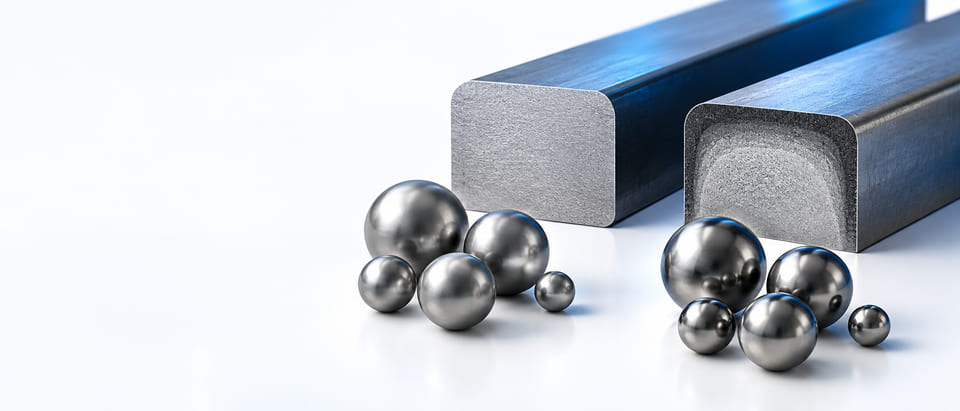
The useful 1010 versus 1085 decision concerns an exact purchased component. This guide connects material designation, finished condition and sample approval without treating surface hardness or a generic carbon-steel description as the whole specification.
Quick Answer: How Should Buyers Choose Between 1010 and 1085 Steel Balls?
Choose the material and finished condition together. AISI 1010 identifies a low-carbon steel direction, while 1085 identifies a high-carbon steel direction. In ball purchasing, these can support different hardening and component requirements. The name alone does not establish the delivered hardness profile, precision, allowable load or application suitability.
The purchasing decision is more specific than a general case-hardening versus through-hardening discussion. An OEM must determine which material requirement is being ordered, what processing outcome it needs and how that exact finished ball will be accepted. Matching diameter or a nominal surface hardness is not sufficient evidence that the other steel is an approved substitute.
For a MEITUO 1085 ball enquiry, share the controlling drawing and explain the duty. If 1010 is proposed instead, identify it as a material change for review. Do not allow a slash-separated catalogue description or a broad carbon steel label to choose the alloy silently on the order.
Which Material Details Must Survive From the Drawing to the Order?
Retain the exact material designation and the specification basis governing it. A buyer should know whether a quotation names the intended material, a commercial reference or a proposed alternative. If several designations appear, ask which one will actually be supplied and who approves any substitution.
Identify the required finished condition separately. A low-carbon steel supplied soft for an attachment task is not the same order as a hardened component made from a low-carbon steel. Likewise, a high-carbon designation does not establish that the required heat treatment has been completed or that its outcome meets the drawing.
Connect the material identity with the delivered lot. Chemistry records and finished-part inspection may come from different stages and organizations; the traceability relationship needs to remain clear. A raw-material certificate without an identifiable connection to the delivered balls may not answer the buyer's actual acceptance question.
Avoid copying typical values from another supplier into the purchase order without engineering review. The relevant requirement may depend on diameter, route, test method and duty. The objective is not to accumulate the most impressive numbers, but to define the component your design actually needs and the evidence that supports it.
The first material-specific purchasing branch is whether the buyer needs a soft component for further work or a finished hardened contact. Published ball catalogues distinguish soft unhardened 1010/1015-type products, case-hardened low-carbon products and high-carbon 1085-type hardened products. That distinction is more useful than treating every carbon-steel sphere as the same stock.
If a downstream operation requires machining, forming, riveting or joining, tell the supplier what is intended and which condition the drawing requires before that operation. A soft low-carbon ball and a hardened contact component can differ substantially in how that operation must be engineered. This does not approve a welding procedure or guarantee workability for a particular feature; the actual material and process still need qualification.
If the purpose is a finished wear contact, specify the material and the finished treatment outcome instead of ordering soft stock and assuming that its receiving appearance proves service readiness. A high-carbon designation such as 1085 provides a different material basis for a hardening route from low-carbon 1010. The actual treatment and final acceptance must remain explicit rather than being inferred from the last two digits of a familiar alloy name.
Ask a proposed seller to choose one described route in its quotation. An offer that alternates between soft, case hardened and high carbon without identifying the delivered condition is incomplete even if its diameter and price are clear.
If 1010 and 1015 appear together in a catalogue, retain the exact designation your drawing requires or the explicit permission to evaluate either. A combined product-family label should not silently broaden an order for one identified material.
How Should the Cross-Section Be Evaluated for the Selected Steel?
If the design depends on material condition beneath the surface, specify the appropriate evidence. A surface hardness reading can be relevant without describing the complete section. The method and acceptance should identify the question being evaluated, such as a defined profile or other required material condition.
Do not describe a hardened region as a separate shell assembled around a loose core. The ball is a continuous material, and processing can establish a property profile through it. A conceptual cutaway can illustrate that distinction, while an actual profile needs specimen preparation, measurement locations and a stated evaluation basis.
The same nominal surface result does not prove that 1010 and 1085 have identical subsurface behavior. It also does not establish a universal performance ranking. Contact, size, treatment and failure mode determine which evidence matters. If the supplier proposes changing the material while maintaining one surface number, review the whole requirement rather than accepting a single matched property.
Keep destructive samples connected to the lot they represent. A laboratory report becomes much more useful when purchasing and quality teams can identify its specimen, method and acceptance. A photograph of a prepared section without that context does not prove the delivered batch.
1010 vs 1085 Steel Balls: Which Purchase Questions Differ?
This table organizes material-specific purchasing decisions without prescribing universal hardness or service limits. The actual steel and processing requirements must be agreed for the component.
| Question | 1010 route | 1085 route |
|---|---|---|
| Material direction | Low-carbon designation as specified | High-carbon designation as specified |
| Order condition | Identify soft or hardening requirements | Identify the required treatment outcome |
| Depth-related evidence | Agree the relevant profile if needed | Agree the relevant internal condition if needed |
| Attachment or contact | Validate the actual interface and duty | Validate the same interface and duty |
| Substitution | Requires approved material review | Requires approved material review |
A buyer may favor a material for its proposed process or economic route, but the engineering rationale must remain visible. A material suited to one attachment task is not automatically suitable for a different rolling or impact contact. Broad labels such as hardware cannot establish the acceptance by themselves.
Ask each quotation to list exceptions. If one supplier offers the drawing material and another offers an alternative steel, compare that difference before comparing prices. Even a promising cost reduction needs an explicit approval basis so it is not mistaken for an unchanged part.
How Should Load, Wear and Attachment Needs Guide the Material Review?
Describe the component's movement and load path. A ball rolling repeatedly against a race, locating a spring-loaded mechanism or being joined to another part may need different material and finished-condition decisions. The industry name on the enquiry is less useful than that physical description.
Inspect the existing failure where replacement is being considered. A dent, fracture, wear mark or corrosion product raises different questions. Preserve the sample and its operating history rather than choosing the alternative solely because it is described as harder or tougher. The apparent damage may originate in a mating component or an unusual event.
Review both partners in the contact. Changing the ball can move the failure to a seat or track. If a joining process is involved, the connection needs its own qualified design and process basis; do not infer joining suitability from a generic carbon steel family name.
A useful material comparison explains the expected benefit, the possible tradeoff and the evidence needed to decide. That makes the proposed 1010 or 1085 route a reviewable engineering option rather than a purchasing preference that relies on untested assumptions.
A practical selection tree can start with three questions. Does the ball still need a downstream fabrication operation? Does the released design require a particular hardened surface or internal condition? Is an existing material being repeated, or is the buyer asking engineering to qualify a different route? The answers direct the enquiry toward a defined 1010 or 1085 condition without assuming one universal winner.
For a fabricated part, the interface created afterward must be evaluated separately from the starting sphere. For a contact part, the mating material and load history govern the useful acceptance. Do not transfer a favorable result from an attachment sample to a rolling contact just because both began with the same nominal ball diameter.
Use different stock identities where soft and hardened versions can coexist in the facility. Their similar shape can make an accidental substitution difficult to notice during a hurried withdrawal. Labels should preserve the actual material and condition, while receiving verifies the evidence the order requires. This is a component-definition control, not a claim that one family always has a particular hardness.
How Can a Material-Specific Quotation Worksheet Reveal a False Saving?
Consider a hypothetical batch comparison with the same agreed quantity. Assume an initial 1010 offer costs 75 currency units and an initial 1085 offer costs 95. The apparent difference is 20 units. These are invented worksheet inputs, not MEITUO prices or typical market costs.
Suppose the first offer excludes a required inspection package valued at 12 units and specified protection valued at 10. Adding those assumed items gives 97 units. The original apparent saving no longer exists under these particular assumptions. This does not mean that 1010 is inherently more expensive or needs those additions; it demonstrates why the offered scope must match.
Complete the technical comparison before applying the cost result. If the material routes are not both approved for the component, their price difference does not establish a purchasing choice. Conversely, if both pass the required validation and the scope is equal, a lower total cost can be a legitimate reason to select one route.
Separate one-time sample qualification from recurring delivery expenses. Keep the approved assumptions and result with the part record so a future buyer does not reuse the price comparison after the drawing, inspection or protection requirement changes.
What Should the Sample and Production Approval Actually Establish?
A sample plan should state material identity, finished geometry, relevant condition and any functional test. Choose methods that answer those specific questions. A dimensional pass does not prove a hardness profile, and a material report does not establish the completed assembly's performance.
Define who approves the material alternative and which record releases it for production. Do not allow sample purchase, visual acceptance and recurring-order approval to become interchangeable milestones. An exploratory sample may be useful while important questions remain open.
Preserve the relationship among drawing revision, accepted sample and production order. If a treatment, source or finishing route changes, decide which part of the earlier approval needs review. A familiar nominal diameter should not conceal a different material condition on the next delivery.
Record lot identity, packaging and receiving requirements in the purchasing brief. These protect the accepted condition and allow a later investigation to distinguish material or process questions from damage or exposure introduced during handling. An approved steel choice becomes useful only when the actual delivered component remains identifiable.
How Should Buyers Compare 1010 and 1085 Ball Suppliers in China and India?
Material terminology deserves attention when a purchasing team compares offers across countries. China and India are used here as relevant examples, not as a ranking of carbon-steel ball capability. The technical comparison should retain the exact material, treatment and acceptance rather than rely on a local commercial shorthand.
Ask every proposed seller to state what it will actually supply and which evidence supports that condition. A broad product-family listing does not settle a particular diameter or processing requirement.
China: a specification-led sourcing review
MEITUO Balls in Qingdao, China can receive an enquiry identifying 1010, 1085 or an explicitly open material question. Attach the drawing and explain whether the design depends on an attachment, a surface contact or an internal property profile. That context is more useful than requesting economical carbon steel balls.
If another material designation is proposed, preserve it as an alternative requiring review. Clarify the quoted seller and the source or processing responsibilities relevant to qualification, then connect the sample and records with the proposed production identity.
India: compare the actual requirement
Dular Steel Products in Agra is an identifiable Indian supplier example for researching steel-ball requirements. Its general product information is a starting point for an enquiry, not proof that a particular 1010 or 1085 condition is available.
Compare the material description and finished treatment against the same released requirement used for MEITUO. Confirm units and document definitions before evaluating a price difference. If the seller uses a different steel designation, request the basis for the proposal rather than interpreting a familiar local name as unrestricted equivalence.
How Can MEITUO Support a 1010 or 1085 Material Decision?
MEITUO Balls is the ball-focused website of Qingdao Meituo Steel Co., Ltd., Qingdao, China. For this topic, the useful enquiry separates the material you require from the finished condition and evidence the component needs.
Provide the current drawing, nominal diameter, material requirement, treatment and duty. If the comparison starts with a failure, identify the symptom and preserve the sample. If it starts with cost, say which alternatives engineering is willing to evaluate rather than presenting a possible change as already approved.
Use the low-carbon ball route and the 1085 ball route to frame the discussion. Include sample and production quantities, inspection expectations and destination.
MEITUO can be considered for a China-based specification-led sourcing review. The actual material, processing or supply route, availability, test scope and commercial terms need confirmation for the order. Do not treat a published family page as proof that every material-and-hardness combination is stocked or that a proposed substitution has already been qualified in your assembly.
1010 vs 1085 Steel Balls FAQ: What Should Buyers Ask?
Are 1010 and 1085 interchangeable carbon steels?
Do not assume so. They identify different material directions and may support different processing outcomes. Review the controlling material and finished-component requirement before substitution.
Does a matched surface hardness prove equivalence?
No. It does not establish the full material condition, profile, geometry or application behavior. Compare the evidence relevant to the design.
Does a material certificate prove treatment?
Not by itself. Material identity and the outcome of processing are different questions. Request the records appropriate to the actual acceptance.
Can a low-priced alternative be chosen before technical approval?
It can be investigated, but a price advantage does not establish suitability. Separate exploratory quotation and sample work from released production approval.
Is the example cost comparison a market quotation?
No. Its values are explicitly hypothetical inputs used to show how missing scope can change a comparison. Use actual offered scope and your own approved costs.
What should MEITUO receive first?
Send the exact material or open alternative, drawing, diameter, treatment requirement, duty, quantity and evidence needed. Identify the decision that engineering must approve.